
Why China Is Being Pulled Deeper Into the Iran Saudi Yemen Crisis
Beijing wants stable energy supplies, secure shipping and workable relations with both Tehran and Riyadh. The widening Yemen conflict, and Iran's own noncommittal response to Chinese pressure, is making it harder to protect all three interests without greater diplomatic involvement.
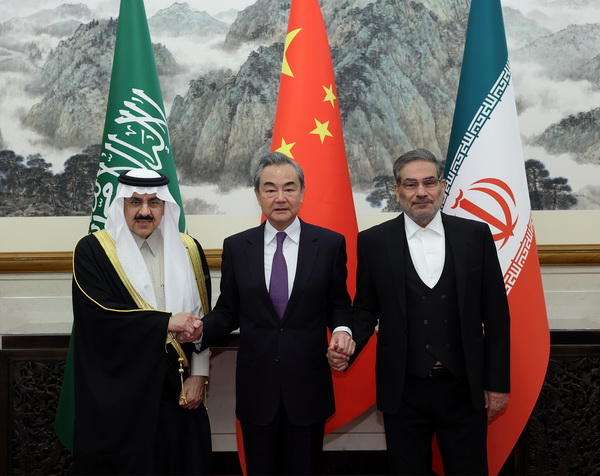
China has spent years presenting its Middle East policy as an alternative to military intervention: trade widely, maintain relations with rival governments, and emphasize stability over political alignment. The latest escalation involving Iran, Saudi Arabia and Yemen is testing how far that model can go, and Iran's own response so far suggests the test is not going entirely Beijing's way.
What Reuters actually reported, in Beijing's own words
Reuters reported this week that China privately asked Iran to help restrain Yemen's Houthis after Saudi Arabia appealed to Beijing for assistance, following rapid Houthi advances along the Red Sea coast and around the Bab el Mandeb, a maritime passage central to global trade and energy flows. Asked by Reuters for comment, China's Foreign Ministry did not merely gesture at restraint in general terms. China does not want regional tensions to spill further into Yemen and the Red Sea, the ministry said. Escalating regional instability is not in any party's interest. It added that all countries' sovereignty and security should be respected, and facilities vital to people's livelihoods must not be targeted, calling for resolving issues through dialogue and negotiation. A senior Western diplomat in the region put Beijing's position more bluntly to Reuters. Beijing is one of the few capitals that can still press Iran to rein in the Houthis, the diplomat said.
How Iran actually responded, which matters as much as the request itself
That leverage, however, appears to have produced a noncommittal answer rather than a concrete commitment. According to the Iranian sources cited by Reuters, Tehran's response to Beijing's request was to say that regional stability required the United States and Israel to end their war against Iran first, effectively redirecting responsibility rather than committing to restrain the Houthis. The exchange reportedly came around the same period as Iranian Foreign Minister Abbas Araghchi's September 16 meeting in Beijing with his Chinese counterpart Wang Yi. However, Reuters's sources did not specify whether the Houthi request was raised directly in that meeting.
Why China has unusual access on both sides
China has unusually strong relationships on both sides of this regional divide. It has been Iran's largest trading partner for more than a decade. It remains the principal buyer of Iranian oil, with Chinese purchases accounting for more than 80 percent of Iran's seaborne oil exports in 2025, averaging about 1.4 million barrels per day, according to commodities data firm Kpler. China also has deep commercial and energy relationships with Saudi Arabia and the other Gulf states. That combination gives Beijing access that many other major powers do not have. It also creates competing obligations and expectations. Saudi Arabia has reason to expect China to use its relationship with Tehran when Houthi military activity threatens Saudi territory, oil infrastructure or shipping. Iran, meanwhile, sees China as an essential economic partner amid war and sanctions, but, as its response to Beijing's request suggests, does not necessarily share Beijing's priorities on every regional question.
Why influence over Tehran is not the same as control over Yemen
The Houthi factor makes the problem even more complicated. Iran has armed and supported the movement, according to Western governments and Iranian sources cited by Reuters, but the Houthis have their own leadership, interests and military calculations. Chinese influence over Tehran therefore does not automatically translate into control over decisions in Yemen, and Iran's deflection suggests Beijing cannot assume its economic leverage will translate into the specific outcome Riyadh seeks.
The geography that makes this China's problem too
China's economic exposure nevertheless gives it a powerful reason to keep trying. The strategic geography is unforgiving. Instability around the Bab el Mandeb threatens the Red Sea route to the Suez Canal, while disruption around the Strait of Hormuz pressures another critical energy corridor. Serious instability affecting both routes at the same time would be especially damaging to an economy as dependent on maritime trade as China's.
A harder test than the one Beijing already passed
Beijing has demonstrated it can play a diplomatic role in the region before. China brokered the 2023 agreement that restored diplomatic relations between Iran and Saudi Arabia, an achievement that strengthened its claim that economic relationships can underpin political mediation. The current crisis is a tougher test. Restoring diplomatic relations required two governments to make a negotiated political choice. Restraining a regional conflict involving states, armed movements, maritime routes and an active confrontation with the United States requires influence over a much wider set of actors, and Iran's own response indicates that influence has real limits even with Beijing's most important economic partner in the region.
The choice Beijing has tried to avoid making
There is also a real question about the limits of Chinese leverage more broadly. Reuters reported that Beijing did not threaten Iran with economic consequences if Tehran failed to act on its concerns. That distinction matters. Diplomatic access is not the same as coercive power, and China's request so far appears to have been answered with deflection rather than action. China therefore faces a choice it has often tried to avoid in the Middle East. It can continue to call for restraint while protecting its relationships with all sides, or it can use more of its economic and diplomatic weight, including the leverage implicit in being Iran's largest oil customer, to shape the behavior of partners whose actions threaten Chinese interests. Neither option is simple. Greater pressure on Iran could damage an important strategic relationship. Too little pressure could weaken China's credibility with Saudi Arabia and other Gulf partners while leaving vital shipping and energy routes exposed.
What this actually tests
This is why the Yemen escalation matters beyond Yemen. It is forcing China to confront the difference between having influence and using it. Iran's own noncommittal response to a direct Chinese request is the clearest evidence yet of where that difference actually lies. For years, Beijing benefited from being commercially indispensable while remaining politically cautious. The Iran-Saudi-Yemen crisis, and specifically how Tehran responds in practice rather than in a private conversation, may show whether that approach remains sustainable when China's own energy security and trade routes are directly at risk.
Comments
Join the conversation
Enter your email — we'll send a 6-digit code so you can post a comment. No password needed.
- Be the first to comment.