Turkiye, Saudi Arabia and Pakistan Sign Mecca Defence Pact as Middle East Tensions Escalate
Three of the Muslim world's most powerful states have formally bound their security together, a signal of how far confidence in Washington's old guarantees has fallen.
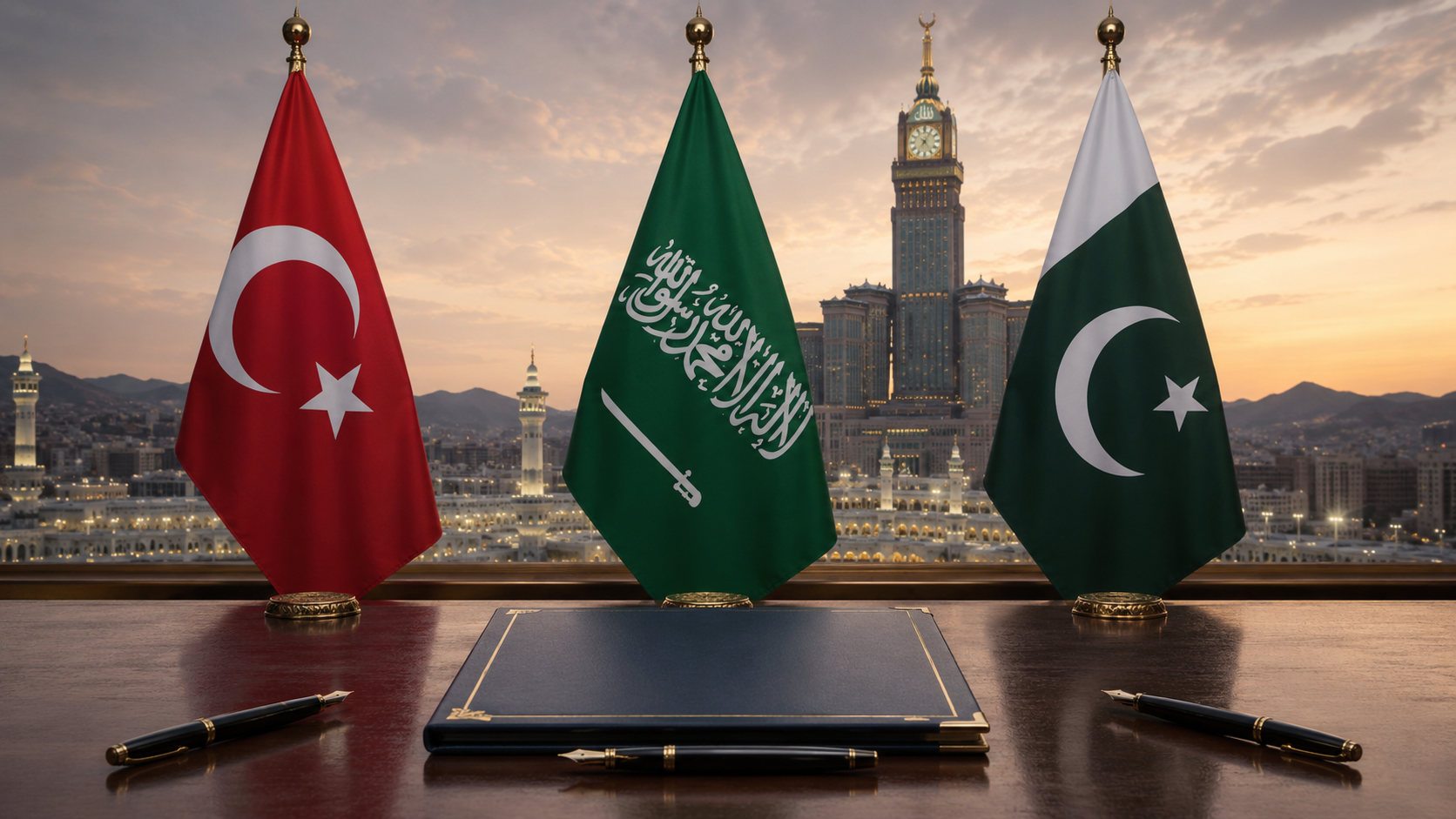
On Friday, in the holiest city in Islam, three of the Muslim world's most consequential states put their signatures on something that had been quietly negotiated for nearly three years. Turkish President Recep Tayyip Erdogan, Saudi Crown Prince Mohammed bin Salman and Pakistani Prime Minister Shehbaz Sharif signed what is now called the Mecca Joint Defence Agreement, a pact stating that an armed attack against any one of the three shall be regarded as an attack against them all.
The timing was not incidental. Iran and its allies have spent months firing missiles and drones at Gulf energy infrastructure, and Riyadh in particular has borne the brunt of it. The war that began with the US and Israeli strikes on Iran in late February has never really ended. It has simply moved through phases of escalation and pause, and Saudi Arabia has watched its oil exports and development ambitions come under direct threat while wondering how far Washington's protection actually extends.
A Pact Born of Doubt in Washington
What makes this agreement significant is not just its content but its context. For decades, the security architecture of the Gulf rested on an unspoken bargain: oil for protection, with the United States as guarantor. That bargain has looked increasingly threadbare in recent months. Saudi Arabia has faced repeated Iranian and Houthi strikes, and the American response has often felt slower and thinner than the kingdom expected.
This is the deeper story behind the Mecca pact. It builds on the bilateral Strategic Mutual Defence Agreement that Saudi Arabia and Pakistan signed in September 2025, itself a response to Israel's strike on Hamas figures in Doha. Now Turkiye has been added to the mix, bringing NATO's second largest military into the arrangement. As one Saudi crown prince aide put it at the time of the earlier bilateral deal, the goal was "one front against any aggressor, always and forever."
Michael Kugelman, a senior fellow at the Atlantic Council who follows South Asia closely, described the pact as bolstering Riyadh's leverage "as it both copes with an emboldened Iran and confronts the limits of US deterrence in the region." That is a striking phrase to see from a Washington based analyst, and it captures something Gulf officials have been saying quietly for months but rarely on the record.
Three Countries, Three Kinds of Strength
The appeal of this trio lies in how well their capabilities complement one another. Saudi Arabia brings the world's largest oil export capacity and deep financial reserves. Turkiye brings a mature domestic defence industry and combat experience from Syria, Libya and the Caucasus. Pakistan brings a battle tested military and, unmentioned but understood by everyone in the room, the only nuclear arsenal in the Muslim world.
Ozgur Unluhisarcikli, a Turkish analyst who studies the country's foreign policy, told Al Jazeera the three partners bring complementary strengths: "Turkey's defence industrial capabilities, Saudi financial muscle and influence, and Pakistan's military experience and strategic deterrent." He was careful to add that this framework represents closer strategic and military coordination among three influential regional powers, not a formal alliance bloc in the NATO sense.
Turkish Foreign Minister Hakan Fidan made a similar point to the state run Anadolu Agency, describing the pact as "technically" comparable to NATO's Article 5, though he stressed that any response would depend on circumstances and would need to be specifically requested by the country under attack, whether that meant intelligence sharing, logistics support, ammunition, or the deployment of troops. Fidan was also explicit that preparations for the deal had been underway for nearly three years, which undercuts the idea that this was simply a reaction to the current crisis.
Tehran Shrugs, Then Pushes Back
Iran's public response has been a study in contradictions. Foreign ministry spokesperson Esmaeil Baghaei told reporters in Tehran that Iran saw no reason to view the pact as a threat, framing it instead as evidence of a broader regional shift "toward greater reliance on the states own capabilities rather than outside powers." That is a notably calm read from a government that has spent the past several months trading fire with Gulf targets.
But that calm has not been universal inside Iran's political establishment. Ebrahim Rezaei, a member of parliament's National Security and Foreign Policy Committee, wrote on social media that "the Saudis should understand that a paper agreement with Turkiye and Pakistan will not bring them security, just as decades of one sided dependence on the Americans failed to do so." Fellow committee member Mahmoud Nabavian offered a similar warning, suggesting Riyadh was simply trading one unreliable guarantor for another.
Turkiye, for its part, has gone out of its way to insist the pact is not aimed at Tehran. "There is no common threat that we have put in writing," Fidan said, adding that any state that does not attack the signatories has nothing to fear from the agreement, and that the framework remains open to other regional countries that wish to join.
What It Does Not Do
It is worth being precise about the limits of this agreement. It is not a NATO style alliance with a standing command structure. It does not extend Pakistan's nuclear umbrella to its new partners. Mansoor Ahmed, a defence analyst at the Australian National University, noted that Pakistan's nuclear posture remains oriented squarely toward the perceived threat from India, and that a formal extension of deterrence to Riyadh or Ankara is unlikely in the near term. What Pakistan and Turkiye do bring, he said, are established defence industries, while Saudi Arabia offers financial and technological investment in return.
Rich Outzen of the Atlantic Council's Turkey Program framed the deal in more structural terms, calling it "an inflection point in the emerging multipolar order in the Middle East and South Asia." For Ankara, he argued, the pact widens a security umbrella that already extends informally to Qatar, Syria and Libya, reinforcing the broader principle that regional powers, not outside actors, should shape the region's political order.
A Region Rewriting Its Own Rules
Whatever the precise legal architecture, the symbolism is hard to overstate. Three of the world's most populous and militarily significant Muslim majority nations, representing NATO's second largest army, the Islamic world's only nuclear power, and the Arab world's only G20 economy, have now formally bound their futures together. It happened not in Washington, not in Brussels, but in Mecca, in front of Islam's holiest site, at a moment when Gulf states are openly questioning whether the old security guarantees still hold.
Whether the Mecca pact ends up reshaping the Middle East's security order or simply formalizes ties that already existed will depend on how the Iran conflict evolves in the months ahead. But the message it sends is already clear enough. When Riyadh, Ankara and Islamabad start signing defence pacts in the holiest city in Islam, it tells you something about how much confidence remains in the old order, and how little.
Comments
Join the conversation
Enter your email — we'll send a 6-digit code so you can post a comment. No password needed.
- Be the first to comment.