
Trump Met Xi at the Airport. He Did the Same for Putin Last Year
Donald Trump’s decision to personally receive Xi Jinping at Joint Base Andrews looked unprecedented. It was not. Read alongside his welcome for Vladimir Putin in Alaska, it reveals a deliberate pattern, not a one-off signal about China.
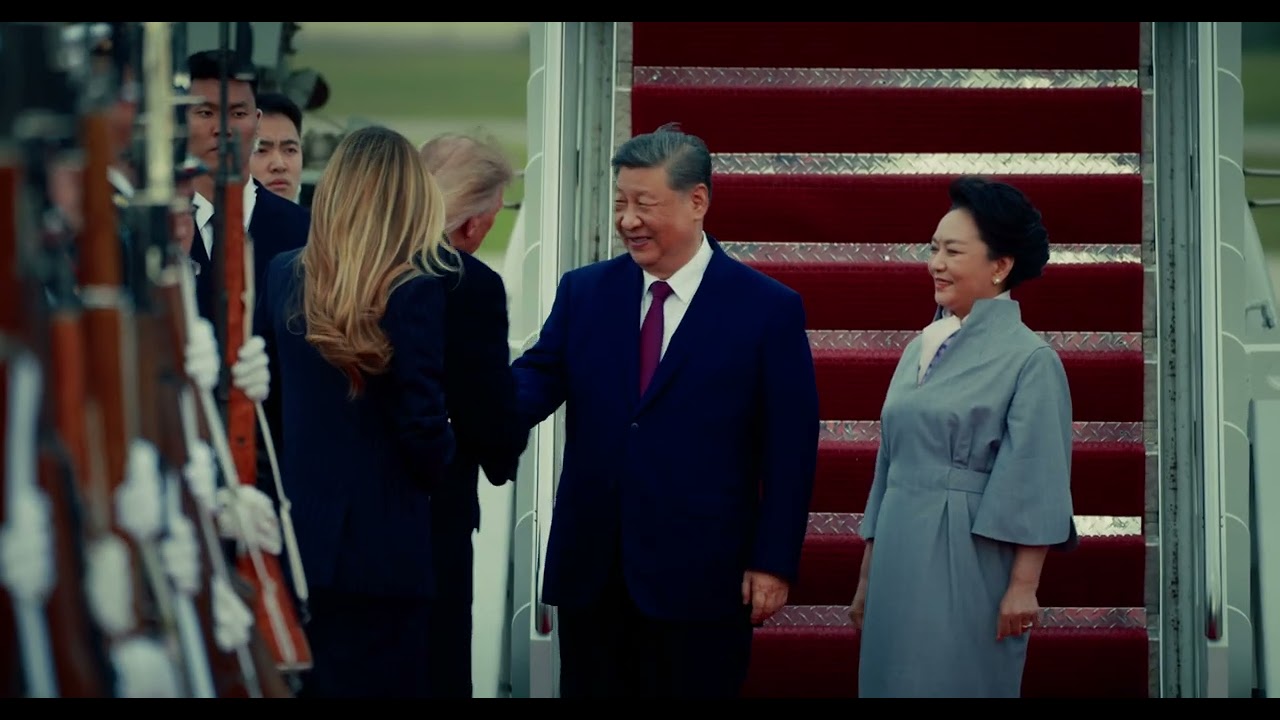
When Xi Jinping’s aircraft touched down at Joint Base Andrews just before 6 p.m. on Wednesday, Donald Trump was waiting at the bottom of a hundred-foot red carpet.
American presidents normally receive visiting foreign leaders at the White House. According to reporting from The Washington Post and Axios, the last time a US president personally greeted a non-papal foreign leader at Andrews was John F. Kennedy in 1962. George W. Bush greeted Pope Benedict XVI there in 2008, and Barack Obama greeted Pope Francis in 2015, but those are treated as a separate category of ceremonial exception. Against that history, Trump travelling to the airport for Xi looked like a genuinely unusual elevation of one relationship above the normal rhythm of American diplomacy.
The comparison that changes the reading
It was not unprecedented, however, and this matters for how the gesture should be read. Trump personally greeted Vladimir Putin on the tarmac at Joint Base Elmendorf Richardson in Alaska last year, going so far as to invite him into the presidential motorcade. That means Wednesday’s welcome for Xi was the second time, not the first, that Trump has used a personal airport reception as a diplomatic instrument. Read in isolation, the Xi welcome could be interpreted as a signal specifically about how Washington now regards Beijing. Read alongside Alaska, it looks more like a tool Trump has decided to deploy for the specific handful of leaders whose relationship with the United States he judges important enough to manage personally, at the highest level of ceremony he controls, regardless of whether that leader is a strategic competitor or a wartime adversary’s president.
What the ceremony itself communicated
The ceremony left little room to argue this was a modest courtesy. According to the Hill’s reporting, the arrival included a cannon salute, a 21 person honor cordon, two three person color guards carrying the American and Chinese flags, six F 16s and six F 22s lined up on the tarmac, the US Air Force band playing Fanfare and both national anthems, and a flyover by two B 1 bombers as the ceremony concluded. Two children presented bouquets to the arriving delegation. First Lady Melania Trump, appearing on Fox News earlier that day, offered a simple explanation for the scale. He’s coming on our soil, and we need to welcome them with the most respect, she said, adding that the two leaders have a great relationship.
The White House’s own explanation, and its limits
The White House offered a related but more specific account. Spokesperson Anna Kelly told Axios that President Xi hosted President Trump in China for a historic summit this summer, and President Trump is reciprocating his hospitality by welcoming the Chinese delegation for a reciprocal visit this week. That explanation is credible and consistent with how diplomatic reciprocity normally works. But it is worth noting precisely what Trump received in Beijing in May, since reciprocity is doing real interpretive work here. When Air Force One landed at Beijing Capital International Airport, Xi did not come to the tarmac. Vice President Han Zheng led the reception, with an honour guard, a band and flag-waving youth. Xi’s own welcome for Trump came the following day outside the Great Hall of the People, with a military review Trump later called incredible. Trump’s Andrews welcome for Xi therefore went further than what Trump himself received in China, which makes the reciprocity framing only a partial account of the choice.
What actually got done, not just performed
The visit was not purely ceremonial. The Trump administration announced the same day that Washington and Beijing had agreed to a two-month extension of a trade truce that was due to expire, according to France 24, giving Wednesday’s arrival a concrete, substantive outcome to sit alongside its symbolism. The three-day visit’s agenda, according to ABC News, covers artificial intelligence safety, Taiwan, trade, the war in Iran and critical minerals, the same list of hard disputes that made a warm welcome analytically interesting in the first place rather than simply redundant.
Not everyone at home read it as a good idea
The reception was not uniformly welcomed inside the United States. The Hill reported that Trump’s approach to the visit drew criticism from key Republicans and widespread condemnation from Democrats, aimed less at engaging China than at the scale and warmth of the ceremony extended to a strategic competitor. That domestic reaction is itself part of what the gesture communicated, since it shows the welcome was read at home as a genuine departure from how a rival power is normally received, not as an uncontroversial pleasantry.
What Xi said, and what that does and does not prove
Xi’s own remarks, published by China’s Ministry of Foreign Affairs, called for China and the United States to strengthen communication, cooperate where possible and prevent competition from turning into confrontation, while emphasizing the two countries’ deeply intertwined interests. Those are Beijing’s stated positions, offered in the context of a carefully staged visit, and should not be mistaken for evidence that the underlying disputes over Taiwan, technology and trade have been resolved. They have not.
Why competitors still choose ceremony
Ceremony becomes most interesting precisely when relations are difficult. There would be little to analyze in an elaborate welcome between governments whose interests already align. The symbolism carries more weight when two strategic competitors, amid disputes over artificial intelligence, rare earths, trade, and Taiwan, deliberately perform mutual respect in public while continuing to negotiate hard positions in private. China and the United States now occupy a relationship that resists a single label. Their economies remain deeply intertwined even as both governments try to reduce specific strategic vulnerabilities. Under those conditions, and precisely because Trump has now applied the same tool to Xi that he applied to Putin, communication managed at the level of two presidents functions as a form of deliberate risk management rather than an incidental courtesy.
What the gesture does not tell us
None of this tells us whether Trump and Xi will resolve their disagreements, whether the newly extended trade truce becomes durable, or whether the dangers surrounding Taiwan recede. What Wednesday’s airport ceremony, read against Alaska rather than in isolation, actually tells us is that Trump has developed a repeatable diplomatic instrument for the handful of foreign leaders he judges most consequential to manage personally, and that he has now used it on both the leader of Russia and the leader of China within roughly a year of each other. Sometimes diplomacy begins before anyone enters the negotiating room, and sometimes the choice of who gets met at the tarmac, and who does not, says as much about Washington’s actual priorities as anything said inside it.
Comments
Join the conversation
Enter your email — we'll send a 6-digit code so you can post a comment. No password needed.
- Be the first to comment.