Analysis: Is Human Rights Still a Value, or Just an Instrument of Convenience
Governments across the political spectrum accuse each other of double standards on human rights. The uncomfortable truth may be that the accusation is usually correct, no matter which government makes it.
Few accusations in international politics travel as far, or land as differently depending on who makes them, as the charge of human rights double standards.
The most striking recent version of this critique did not come from a government accused of abuses defending itself. It came from Amnesty International's leadership. In her reflections on the state of human rights for 2025 and 2026, Secretary General Agnes Callamard did not soften the language of the movement she leads. Millions, she wrote, have been denied the protections human rights are supposed to guarantee, citing Palestinian victims of what she termed genocide, apartheid and occupation in the context of Israel's conduct, Afghan women living under what she called an open-air prison, and Iranian protesters subjected to what she described as perhaps the largest mass killing in the country's recent history. Callamard specifically criticized the rhetorical framing offered by US Secretary of State Marco Rubio, who in a widely noted early 2026 speech described a new international order as a Western alliance of Christian people rooted, in his words, unapologetically and proudly in a common heritage. Callamard's rejoinder was blunt: that heritage, she wrote, is also a history of domination, colonialism, slavery and genocide, and cannot be romanticized without acknowledging that history.
The case that economic interest routinely wins
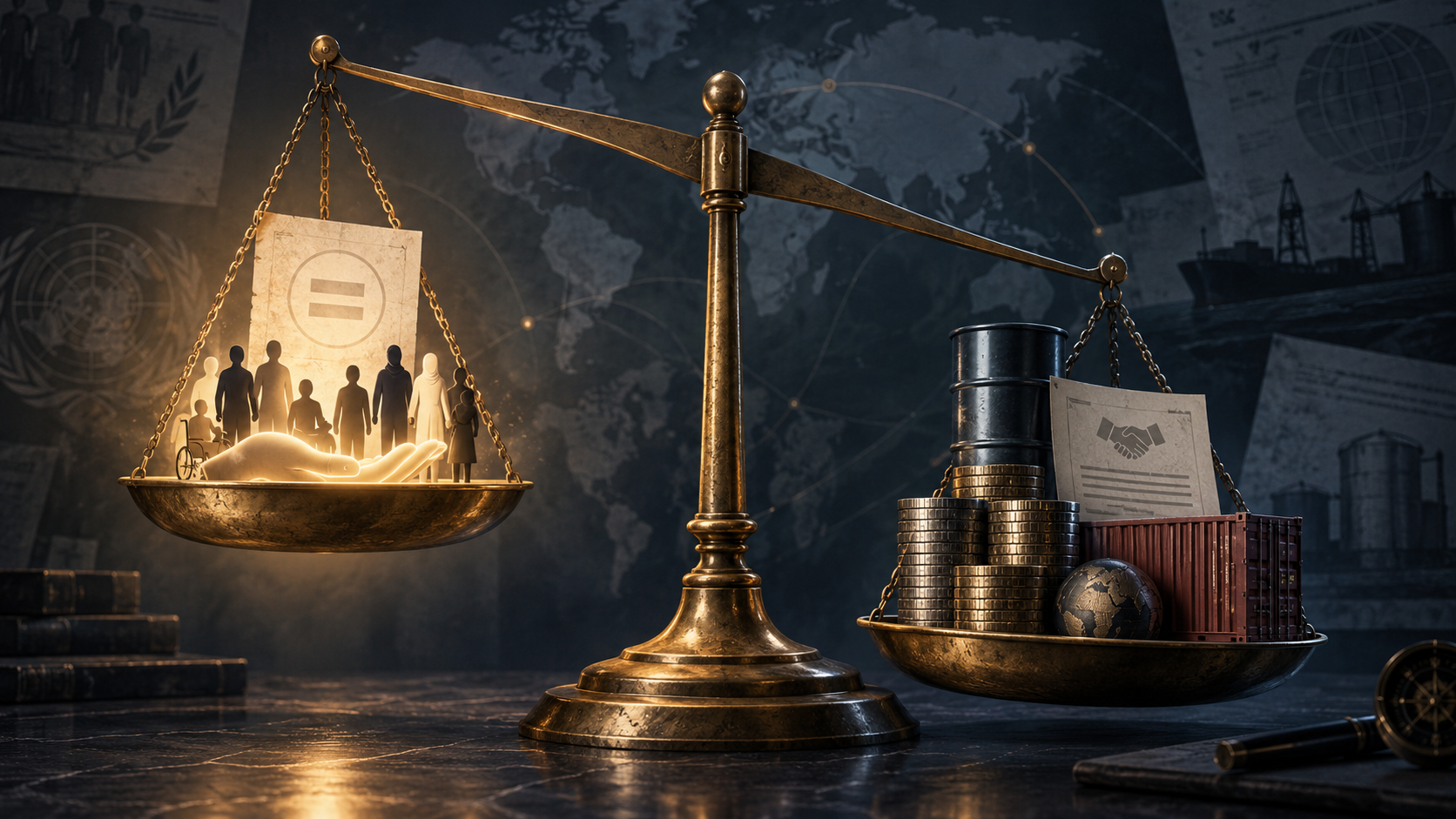
The pattern Callamard describes, serious documented abuses met with muted or selective international response, recurs across cases with different political valences. Analysts examining the gap between Western governments' human rights rhetoric and their actual policy point most often to relationships where economic or strategic interests are large: continued arms sales and security cooperation with governments facing credible allegations of serious rights violations, aid and trade relationships that persist largely unaffected by documented abuses, and a general pattern in which criticism intensifies sharply for governments outside a country's core alliance network and softens considerably for governments inside it. One recent analysis specifically pointed to the contrast between how the United States and its allies have addressed rights concerns involving Israel and India, respectively, arguing that strategic interest in both cases has demonstrably outweighed stated human rights concerns, producing what the analysis called a system of privileged standards for favoured partners. Critics writing from Global South perspectives go further, arguing that human rights conditionality attached to Western aid and International Monetary Fund lending has functioned less as principled enforcement and more as an instrumental tool that constrains the policy choices of borrower nations while leaving creditor nations largely unconstrained by the same standards.
The case that this critique itself gets weaponized
It would be a mistake, however, to treat the double standards charge as a uniquely Western failing, or as an argument advanced only in good faith. Governments accused of serious rights violations have become fluent in redirecting the same accusation outward, often without addressing the underlying allegations at all. Chinese Foreign Ministry spokespeople have repeatedly responded to Western criticism over the treatment of Uyghur and Tibetan populations not by engaging the specific evidence, but by citing documented Western problems with racism, gun violence, and the treatment of Indigenous populations and refugees, and by characterizing the original criticism as hypocrisy and ideological bias. During one such exchange at the UN Human Rights Council, a Chinese spokesperson noted that more than one hundred countries, led by Pakistan, had issued statements supporting China's position and rejecting what they described as the politicization of human rights. That the specific abuses being described- documented mass detention on one hand and documented policing and inequality problems on the other- are not actually comparable in scale or mechanism tends to disappear once the exchange becomes a contest over who gets to sit in judgment of whom. Russia and other governments facing international criticism over their own conduct have used structurally identical rhetorical moves. The double-standards accusation, in other words, functions simultaneously as a genuine critique of Western foreign policy and as a deflection tool available to any government facing scrutiny, and distinguishing between the two uses in any given instance requires examining the specific evidence, not simply noting that the accusation was made.
Is human rights a Western imposition, or a genuinely contested universal claim
A separate and older debate complicates this picture further: whether human rights, as a framework, is itself a Western construct applied unevenly, or a genuinely universal claim that different states violate to different degrees and are held accountable unevenly. Historical accounts of the 1948 Universal Declaration of Human Rights complicate the simplest version of the Western imposition argument. Latin American and African states played a substantial role in shaping the declaration's development in the years that followed, and the abstaining states in 1948 included Saudi Arabia and apartheid South Africa, hardly a clean East versus West or Global North versus South divide. That history does not resolve the present-day argument that human rights language is sometimes deployed selectively as a tool of what critics call neo-imperialism, particularly when Western governments combine human rights criticism with trade sanctions or aid conditions applied unevenly, while their own border and asylum policies draw comparatively less international scrutiny of a similar kind.
An answer, not a comfortable one
So is human rights no longer a value? The evidence suggests a more uncomfortable answer than either a flat yes or no. Human rights remains a real value for individuals, organizations, and even some governments who invoke it consistently, including when doing so is costly to their own alliances, as Amnesty International's leadership demonstrated by criticizing close Western allies as sharply as adversarial states. But as a matter of state behavior, evidence across multiple governments and ideological camps points to the same pattern: human rights functions as a genuine constraint mainly when it does not conflict with a government's core economic or strategic interests, and as a rhetorical weapon against rivals when it does. That is not a uniquely Western failure, a uniquely Chinese one, or a uniquely anyone's failure. It is closer to a structural feature of how states use moral language in a competitive international system, one that every government participating in that system, whatever its own record, has strong incentives to obscure rather than admit.
Comments
Join the conversation
Enter your email — we'll send a 6-digit code so you can post a comment. No password needed.
- Be the first to comment.