
IMF Raises Global Growth Forecast, but Warns AI Boom Is Leaving Economies Behind
The fund now expects the world economy to grow 3.1 percent in 2026, with AI investment offsetting an energy shock while a smaller group of countries drives the gains.
The International Monetary Fund (IMF) raised its global growth forecast on Tuesday, saying investment in artificial intelligence is helping offset the damage from high energy prices, even as the benefits concentrate in a smaller group of economies.
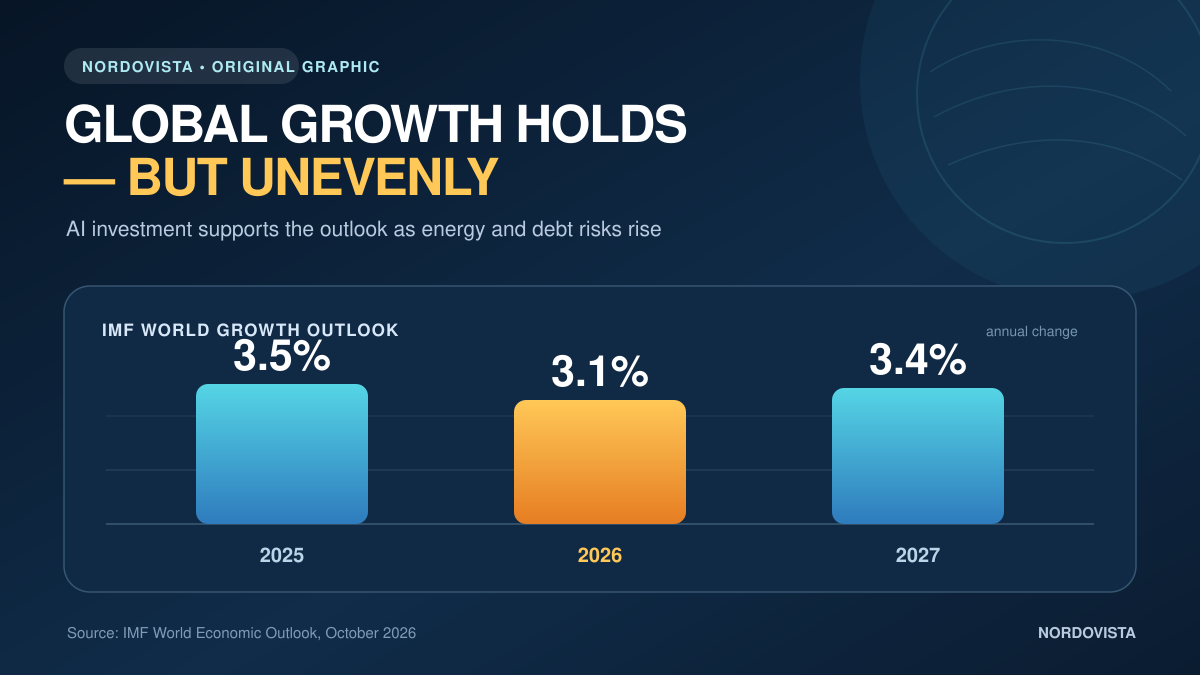
In its October World Economic Outlook, released during the IMF and World Bank annual meetings in Bangkok, the fund projected world growth of 3.1 percent in 2026, up 0.1 percentage point from its July estimate of 3.0 percent. That is below the 3.5 percent expansion recorded in 2025. The IMF expects growth to improve to 3.4 percent in 2027. These are forecasts, not guaranteed outcomes, and depend on assumptions about energy supplies, investment, and the course of regional conflicts.
One leg of the economy
IMF Managing Director Kristalina Georgieva described the situation bluntly. “We now have an economy that is standing on one leg, the AI leg,” she said. Silvana Tenreyro, the fund’s new chief economist, put the same point more cautiously: “The global economy has been resilient, but that resilience is under strain, with risks tilted to the downside.” The IMF says 32 economies now account for 95 percent of global growth, down from 54 in April, and about 47 percent of economies had their forecasts cut. A stronger global average can therefore coexist with weaker prospects for many countries.
Energy and inflation
The IMF’s baseline assumes the Strait of Hormuz reopens in March 2027, with oil averaging about 95.74 dollars a barrel in 2026 and 87.39 dollars in 2027, according to Xinhua’s summary of the outlook. A prolonged closure would be more damaging: reporting says oil above 130 dollars through the first quarter of 2027 would cut 2027 growth by 0.5 percentage point. Global inflation is forecast at 4.7 percent in 2026 before easing to 4.1 percent in 2027. Among major economies, the IMF projects growth of 2.3 percent for the United States, 1.1 percent for the euro area, and 7.0 percent for India, according to Xinhua; it also cut Saudi Arabia’s 2026 outlook by 5 points to a 3.3 percent contraction.
The risk inside the boom
The IMF has also identified a risk in the technology investment itself. If companies invest heavily without achieving the expected productivity gains, a sharp reassessment could weaken markets and spending. Reporting on the outlook says an AI correction could cut global output by 1.1 percent by 2028, including a 1.8 percent fall in United States output. It notes that AI-related goods trade grew 29 percent from 2023 to 2025, against 8.3 percent for global trade. Those figures come from an aggregator’s summary of Reuters reporting and should be checked against the IMF’s report.
Growth is not the same as living standards
Increased spending on AI infrastructure can lift national output without immediately improving wages or job security across the wider workforce. Georgieva has also described the effects on jobs as “a slow-moving tsunami, but a tsunami nonetheless.” The IMF’s earlier research estimated that about 40 percent of jobs worldwide would be augmented, downgraded, or eliminated by AI, which does not mean every affected job will disappear.
What it means for Canada
For Canada, the report raises a question that extends beyond the global forecast: how much of the investment wave can translate into domestic productivity, employment and durable business capacity, rather than higher technology costs alone. NordoVista did not find Canada’s figures in the reviewed report and does not estimate them.
The IMF report's central message is mixed. The global economy has shown resilience, but that resilience increasingly rests on concentrated sources of investment and on assumptions that major external shocks will not worsen.
Comments
Join the conversation
Enter your email — we'll send a 6-digit code so you can post a comment. No password needed.
- Be the first to comment.