Carney Meets First Nations Leaders and Premiers, Promises Process to Move Beyond Indian Act
The first meeting of its kind in two decades produced funding announcements and talks on a First Nations sovereign wealth fund, while protesters questioned who speaks for First Nations.
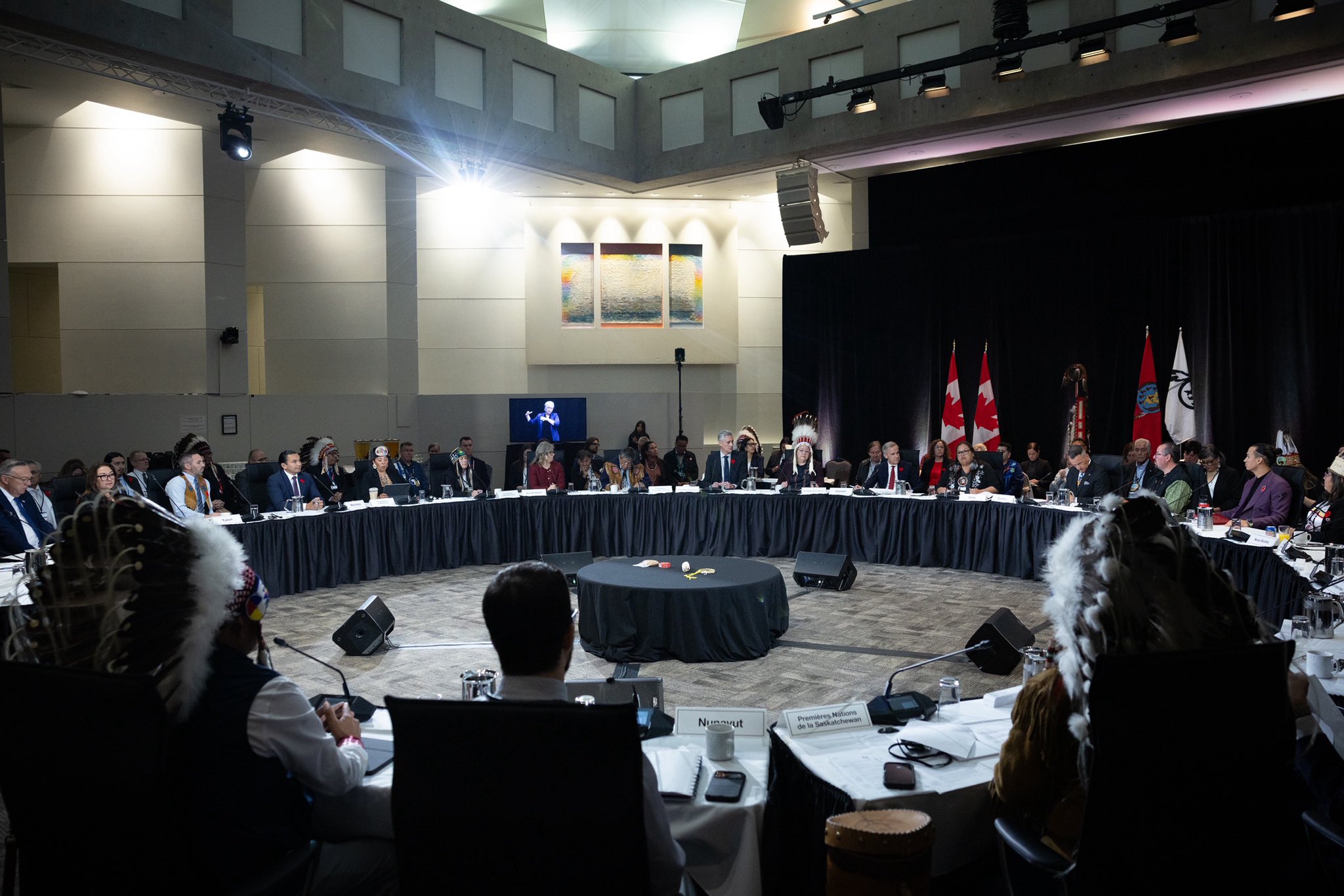
Prime Minister Mark Carney said Monday he is committed to “a process that moves Canada beyond the Indian Act,” after meeting First Nations leaders and premiers in Ottawa for the first time in two decades.
Nearly 200 First Nations chiefs and leaders attended the closed door meeting with Carney and provincial and territorial premiers, according to the Prime Minister’s Office, which said Carney convened it after committing to do so at the Assembly of First Nations’ Special Chiefs Assembly in December 2025.
Carney said he would direct his ministers to work with First Nations on a path beyond the Act, which could mean reforming or abolishing it, APTN News reported. It was not clear when that process would start.
The Indian Act
Manitoba Premier Wab Kinew, who held up his First Nations status card, said during the meeting, “It’s time to abolish the Indian Act,” according to APTN and The Canadian Press. Carney responded afterward, APTN reported, saying the government is also addressing issues within the law, including consultations on the second generation cut off, which ends legal Indian status after two consecutive generations of parenting with a partner who does not have status.
Assembly of First Nations National Chief Cindy Woodhouse Nepinak said consultations would have to be extensive because First Nations across the country will decide for themselves, APTN reported. Nisga’a Nation President Eva Clayton told reporters she supports Carney’s plans and that modern treaty holders attended to support Canada.
Wealth fund and revenue sharing
The leaders agreed to explore new revenue sharing mechanisms, including a possible First Nations Sovereign Wealth Fund, the Prime Minister’s Office said. The finance minister will work with First Nations leaders on how to establish it, with the aim of giving First Nations a direct stake in major projects. The government will also amend the First Nations Fiscal Management Act to expand the lending authority of the First Nations Finance Authority.
These are discussions and proposals, not a completed fund or an agreement on its design.
Funding announcements
The Prime Minister’s Office announced $260 million over four years for a Partnerships for Indigenous Workforce Readiness Fund to connect Indigenous people with jobs on major projects, and said an Indigenous stream of the $8 billion Team Canada Strong initiative is being developed for entry level trades jobs.
It also announced more than $2.5 billion over five years, plus nearly $450 million in ongoing funding, for emergency management and fire protection, and more than $630 million over four years, plus $250 million in ongoing annual funding, to renew and expand First Nations and Inuit policing agreements. A further $140 million over four years is for crime prevention and community safety initiatives, the office said.
Carney described it as “sobering” that this was the first such meeting in two decades, The Canadian Press reported.
Protest outside
Jeronimo Kataquapit protested outside the Diefenbaker Building, saying major projects cannot proceed without free, prior and informed consent and criticizing the lack of youth representation, according to The Canadian Press. Protester Katisha Paul questioned whether the Assembly of First Nations has a mandate to negotiate for First Nations.
The Canadian Press reported that First Nations leaders have warned that Carney’s push to speed major project approvals could affect their rights and lead to court challenges. It named disputes involving British Columbia lands claims, a proposed pipeline in Alberta and development of the Ring of Fire in Ontario.
Comments
Join the conversation
Enter your email — we'll send a 6-digit code so you can post a comment. No password needed.
- Be the first to comment.