
Trump Pauses Tariffs on Canada, Citing Deal Still Being Finalized
Hours before fifty percent tariffs were due to take effect, Trump announced a three day pause and said the two countries have a deal “subject to finalization of documents.” Carney was notably more cautious.
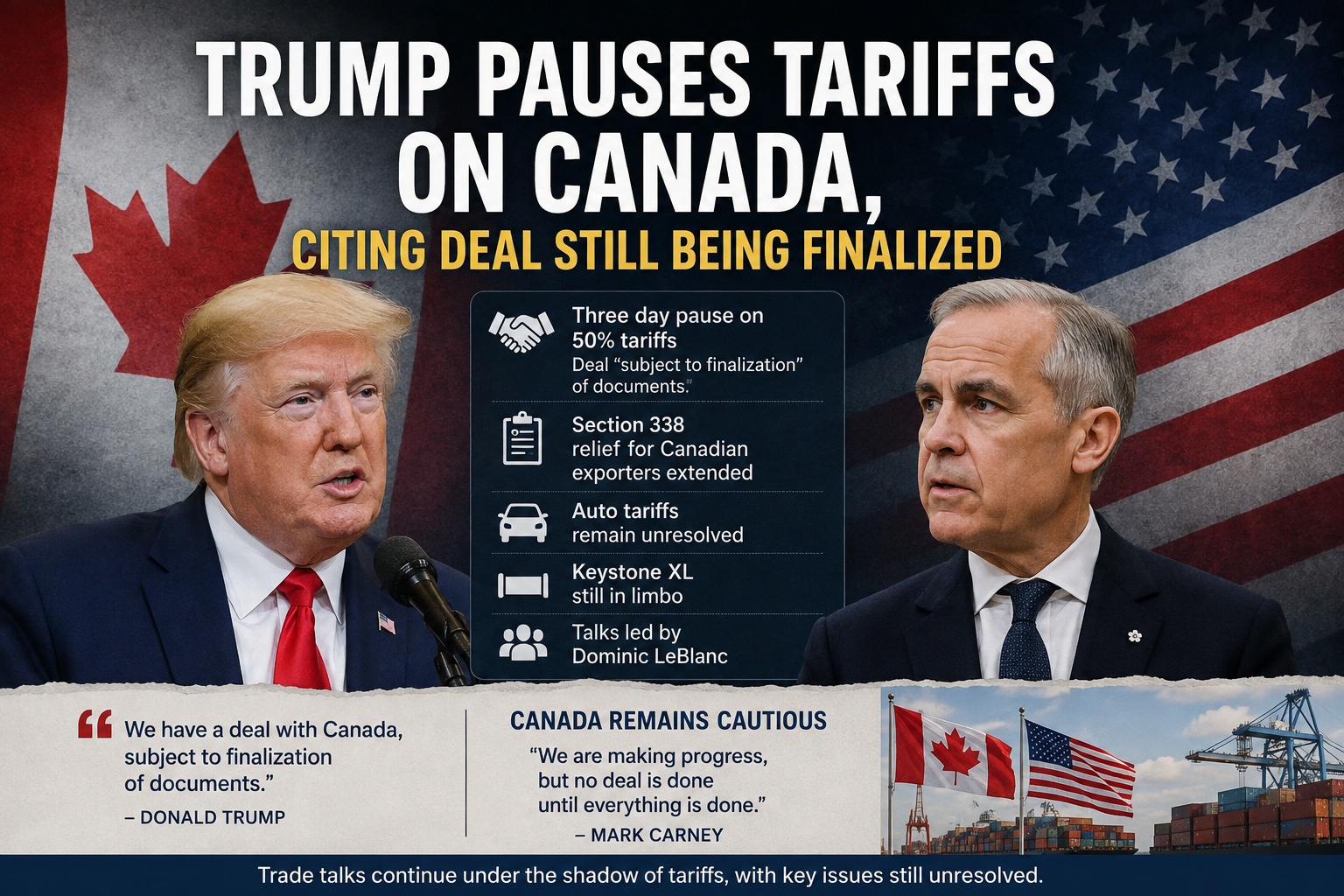
President Donald Trump announced late Tuesday that he was pausing fifty percent tariffs on twenty billion dollars of Canadian goods for three days, saying the United States and Canada had reached a deal, though he provided no details and Prime Minister Mark Carney’s own statement was notably more measured.
I have paused the 50 percent tariffs against Canada, that were scheduled to kick in tomorrow morning for a three day period, based on the fact that Canada and the USA, subject to the finalization of documents, have a DEAL, Trump wrote on Truth Social less than two hours before the tariffs were due to take effect at midnight. He did not describe the deal’s terms, though he referenced the Keystone XL pipeline, a long dormant project he said may be awoken from the grave, and a White House statement said the agreement would include comprehensive market access for American goods, economic security commitments and digital trade alignment.
Carney’s statement, released shortly after, struck a different tone. Substantial progress has been made, although there is important work still to be done, he said, confirming the Section 338 tariffs would be delayed until the end of day Friday rather than describing an agreement as finalized. While we continue this work, Canada remains focused on building a stronger, more independent, and more competitive economy at home, he added.
The pause capped a day of intensive, down to the wire negotiation. Trump and Carney spoke by phone for the second time in two days on Tuesday, and Canadian negotiators, led by trade minister Dominic LeBlanc and chief negotiator Janice Charette, believed by Tuesday afternoon they had arrived at a proposal that could break the impasse, according to a source briefed on the talks and cited by the Globe and Mail. Canada’s ambassador to the United States, Mark Wiseman, was called back to Washington on Tuesday, cancelling a scheduled appearance at a North Carolina chamber of commerce event to do so.
Sources cited by CBC News said the emerging deal is expected to cut the tariff rate on Canadian built vehicles from twenty five percent to fifteen percent, with a further reduction possible depending on how much US made content a given vehicle contains, since North American auto manufacturing is highly integrated. Trump separately told reporters Wednesday that the deal would include no tariffs on Canadian imports of American farm products, saying tariffs will be non existent for farmers, though this description has not yet been confirmed in a signed text.
Reaction from the business community has been measured rather than celebratory. Candace Laing, president and chief executive of the Canadian Chamber of Commerce, said the three day delay offers businesses some relief but falls short of the certainty a signed interim agreement would provide. This limbo state is not anyone’s preferred outcome, she said, urging negotiators to finish the work quickly. The US Chamber of Commerce had separately warned before the pause that a failure to reach a deal risked roughly 13 million American jobs tied to the North American trade agreement, underscoring that both countries had incentive to find an off ramp.
Two premiers spoke publicly in support of the direction of the talks. Saskatchewan Premier Scott Moe said Carney is poised to broker what he called a best in class trade agreement, while Conservative Leader Pierre Poilievre said he was relieved there appeared to have been progress, without endorsing terms that remain undisclosed.
What remains unresolved is significant. The tariffs that were paused would have marked the first ever use of Section 338 of the Tariff Act of 1930, a Depression era provision allowing duties of up to fifty percent on a trading partner found to discriminate against US commerce, and Canadian negotiators have been seeking not only to have those tariffs scrapped outright but also to lower separate Section 232 tariffs on steel and aluminum that remain in place regardless of Wednesday’s announcement. Two sources also told the Globe and Mail that any auto sector agreement is complicated by a parallel deal the White House is separately negotiating with Mexico, given how integrated North American vehicle manufacturing is across all three countries.
Comments
Join the conversation
Enter your email — we'll send a 6-digit code so you can post a comment. No password needed.
- Be the first to comment.