Ottawa Opens Public Consultation on Turkiye Trade Deal While Steel Duties Remain a Live Irritant
Global Affairs Canada wants to hear from Canadians on a free trade agreement with Turkiye through September 14, even as Canada maintains anti dumping duties on Turkish steel that reached nearly 48 percent earlier this year.
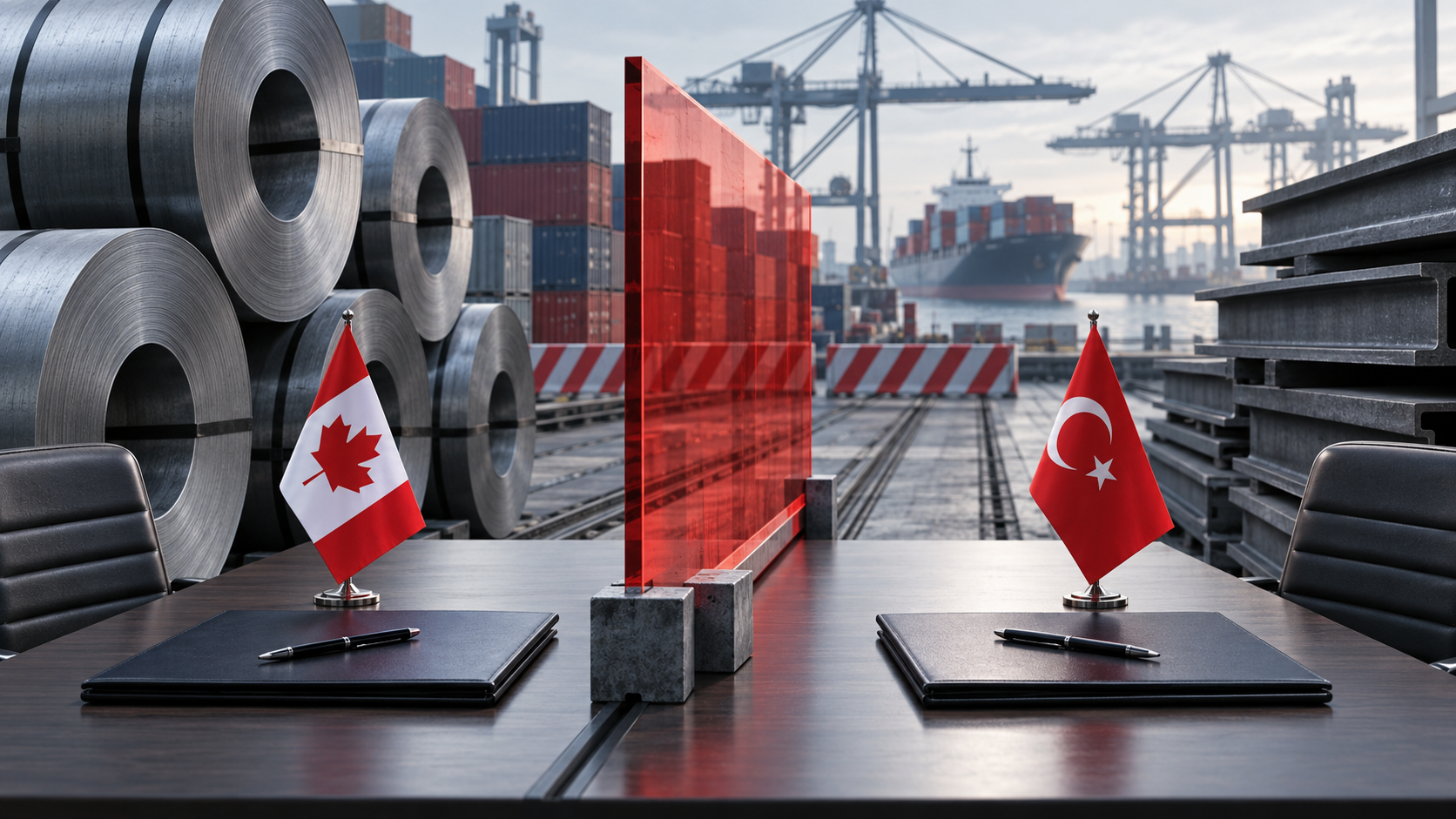
Global Affairs Canada opened a public consultation on July 31 seeking Canadians’ views on a potential free trade agreement with Türkiye, a formal step toward negotiations that began at the political level weeks earlier and now moves into the technical, more complicated work of defining what the deal will actually cover.
The consultation, open until September 14, invites input from businesses, provincial and municipal governments, labour unions, Indigenous peoples, civil society groups and the general public, according to the notice published on Global Affairs Canada’s own consultation page. The department is specifically seeking views on goods that would benefit from expedited or phased-in tariff removal, non-tariff barriers and technical trade barriers, opportunities in services trade, and how the agreement should address labour rights, environmental protection, and the advancement of underrepresented groups, including women and Indigenous peoples. Global Affairs Canada also asked for input on transparency, anti corruption measures, and the protection of human rights and the rule of law, language that mirrors provisions found in several of Canada’s more recent trade agreements.
The trade relationship the negotiators are starting from
According to Global Affairs Canada’s own figures, Canada’s total bilateral merchandise trade with Türkiye reached more than 4.3 billion Canadian dollars in 2025, with Canadian exports totalling approximately 1.1 billion dollars against imports of roughly 3.2 billion dollars. This trade balance runs firmly in Türkiye’s favour. The investment relationship has grown more quickly than trade: the stock of Canadian direct investment in Türkiye reached 3.3 billion dollars in 2025, more than triple the 1 billion dollars recorded in 2022, while Turkish direct investment in Canada stood at a comparatively modest 233 million dollars, making Türkiye Canada’s 24th largest source of European foreign investment and 54th largest globally.
From NATO summit sidelines to a formal process
The push toward a comprehensive agreement moved quickly this year. Turkish Trade Minister Omer Bolat and Canadian International Trade Minister Maninder Sidhu issued a joint ministerial statement in early June announcing exploratory discussions toward a free trade agreement. That groundwork led to a formal announcement on July 7, when Prime Minister Mark Carney and President Recep Tayyip Erdogan, meeting on the sidelines of the NATO summit in Ankara, jointly announced the launch of negotiations toward what their statement called a comprehensive, modern and mutually beneficial agreement. The meeting also covered ground well beyond trade: Carney and Erdogan discussed strengthening allied defence industrial capacity through the Defence, Security and Resilience Bank and expressed interest in deepening cooperation on critical minerals, energy and aerospace, according to a readout published by the Prime Minister’s Office. Technical teams from both countries were tasked with defining the agreement’s scope in the following months, a process the current public consultation now feeds directly into.
A tension the negotiators cannot avoid
The push for freer trade sits alongside an active, ongoing trade defence relationship that will not simply disappear because political leaders have announced negotiations. Canada currently maintains anti dumping and countervailing duties on several categories of Turkish steel. The Canadian International Trade Tribunal ruled in January 2026 that dumping of Turkish origin carbon and alloy steel ring imports caused injury to Canadian producers, with the Canada Border Services Agency setting a final dumping margin of 47.9 percent on Turkish exporters. Separately, on July 16, just two weeks before the FTA consultation opened, the Tribunal completed an expiry review and determined that ending existing anti dumping and countervailing duties on Turkish corrosion resistant steel sheet would likely lead to renewed dumping and subsidization, meaning those duties, currently ranging up to 26.1 percent with additional subsidy rates up to 3.6 percent, will continue. Turkish carbon and alloy steel wire has faced similar measures, with dumping margins as high as 158.9 percent found in a December 2025 determination covering multiple countries including Türkiye.
None of this means the steel disputes will derail the broader negotiation. Trade agreements routinely proceed alongside sector specific trade remedy measures, and Canada’s own consultation notice explicitly invites input on import sensitivities, a category into which the domestic steel industry’s concerns would fall. But the timing is a useful reminder that a free trade agreement announced at the level of national leaders still has to be negotiated against a backdrop of specific, ongoing disputes at the industry level, and Canadian steel producers who have spent much of the past year defending existing duties against Turkish imports will be watching the negotiation’s scope closely.
What happens next
Global Affairs Canada has not published a timeline for when formal negotiating rounds will begin, saying only that technical teams will use the coming months to define the agreement’s scope following the consultation period. For a relationship currently defined by a trade imbalance favouring Türkiye, rapidly growing Canadian investment, and at least one active category of trade friction, how negotiators reconcile the diplomatic ambition announced in Ankara with the sector-specific realities raised during this consultation will shape what a final agreement actually looks like.
A formal channel for civil society and human rights input
Trade friction over steel is not the only pressure this negotiation will face. The consultation’s own list of stakeholders reaches well beyond business, explicitly naming civil society organizations, non-governmental organizations, labour unions, and Indigenous peoples alongside companies and industry associations. And one of the seven discussion topics Global Affairs Canada listed is not economic at all: opportunities to advance transparency, anti corruption and responsible business conduct, and to promote and protect good governance, the rule of law, and human rights. That places rights and governance questions inside the formal consultation record, not on its margins.
Recent precedent shows what that kind of input looks like in practice. When Canada explored a free trade agreement with China in 2016, Alex Neve, then secretary general of Amnesty International Canada, publicly called on Ottawa to commission an independent assessment of what the proposed deal would mean for human rights, rather than treating economic growth figures as a substitute for addressing documented abuses. Neve’s specific complaint, that a trading partner’s growth statistics are sometimes used to explain away human rights concerns rather than answer them, is the same structural argument advocacy groups tend to raise whenever a human rights sensitive country becomes a trade partner.
Turkiye-specific concerns are also already on the record within the Canadian government itself, not only among outside advocates. In 2017, then Foreign Affairs Minister Chrystia Freeland issued a formal statement expressing serious concern over the detention in Turkiye of elected officials, journalists, academics, and human rights defenders, including, at the time, the head of Amnesty International in Turkiye, along with the closure of media outlets and NGOs. More recently, Canada’s expanding defence relationship with Turkiye, a separate but related track from the trade talks, has drawn direct criticism from within Canada. The Armenian National Committee of Canada objected publicly in May 2026 after a Canadian minister described Turkiye as a trusted partner and valuable ally at a defence expo in Istanbul, pointing specifically to the 2020 diversion of Canadian made drone components to Azerbaijan during the Nagorno Karabakh conflict as evidence that assurances from Ankara have not always held.
The Gulen movement and Turkiye’s human rights record
The specific human rights record likely to feature most heavily in any submissions is Turkiye’s response to the 2016 coup attempt, which the government blamed on a movement led by the exiled cleric Fethullah Gulen and designated a terrorist organization it refers to as FETO. Ankara made that designation, not the international community. Canada has not designated the Gulen movement as a terrorist entity. Public Safety Canada maintains a public list of entities listed as terrorist organizations under the Criminal Code, and the Gulen movement, or FETO, has never appeared on it. According to a UK Home Office report cited by the Stockholm Center for Freedom in January 2026, other than Turkiye, no state party to the European Convention on Human Rights has designated the Gulen movement as a terrorist organization, a gap the report said reinforces concerns that the classification is politically motivated rather than grounded in an internationally recognized legal standard. The United States and the European Union have likewise not designated the movement as a terrorist organization. According to Turkiye’s own Justice Minister Yilmaz Tunc, more than 705,000 people had been investigated over alleged Gulen ties as of July 2024, with rights groups documenting the dismissal of roughly 130,000 civil servants since 2016. This is not solely an advocacy characterization. The European Court of Human Rights, a body Turkiye is bound by as a Council of Europe member, has issued dozens of judgments finding rights violations in individual cases, with a July 2026 compilation by the Justice Square foundation putting the total number of applicants affected at more than 8,000 and combined court ordered compensation at over 20.6 million euros. Turkiye had the highest number of new applications of any country before that court in 2025. A July 2026 independent academic study further found that enforcement has continued to evolve rather than ease, documenting 4,386 detentions in 2025 alone, increasingly based on indirect indicators such as social contacts or financial assistance to affected families rather than direct membership evidence alone. Separately, several governments’ own religious freedom monitoring bodies, including the US Commission on International Religious Freedom in its 2026 annual report, have documented ongoing structural barriers facing other religious minorities in Turkiye, including Alevis, Protestant Christians and Jehovah’s Witnesses, citing obstacles to legal recognition, restrictions on constructing or restoring houses of worship, and residency barriers for foreign born clergy. Ankara’s consistent position is that the prosecutions target a designated terrorist organization responsible for a violent attempt to overthrow an elected government, in which more than 250 people were killed, rather than religious belief itself, and it points to steps such as ongoing dialogue over reopening the long closed Halki Theological School as evidence of an evolving approach on minority religious communities. The Gulen movement has consistently denied any role in the coup attempt.
None of this means the FTA consultation will produce the kind of independent human rights assessment Amnesty International Canada called for in the China case, and Global Affairs Canada’s list of discussion topics does not commit the government to any specific outcome on rights and governance questions, only to considering input on them. Nor does it mean Turkiye’s government would necessarily dispute the premise that trade and governance are linked; Ankara has its own history of raising reciprocal concerns about its trading partners’ records, a pattern common to trade negotiations generally rather than unique to this one. What the record does show is that Canadian civil society groups, and Canada’s own government on at least one prior occasion, have treated Turkiye’s human rights and governance record as directly relevant to the bilateral relationship, and the current consultation gives that constituency a formal, documented channel, backed in this instance by binding judicial findings rather than only advocacy claims, to make the same case again before negotiators define the agreement’s scope.
Comments
Join the conversation
Enter your email — we'll send a 6-digit code so you can post a comment. No password needed.
- Be the first to comment.