
Canada's LNG Expansion Puts Economic Ambition and Climate Accountability on the Same Ledger
The case for new export capacity is becoming clearer. So is the need to measure its economic and environmental claims against results rather than slogans.
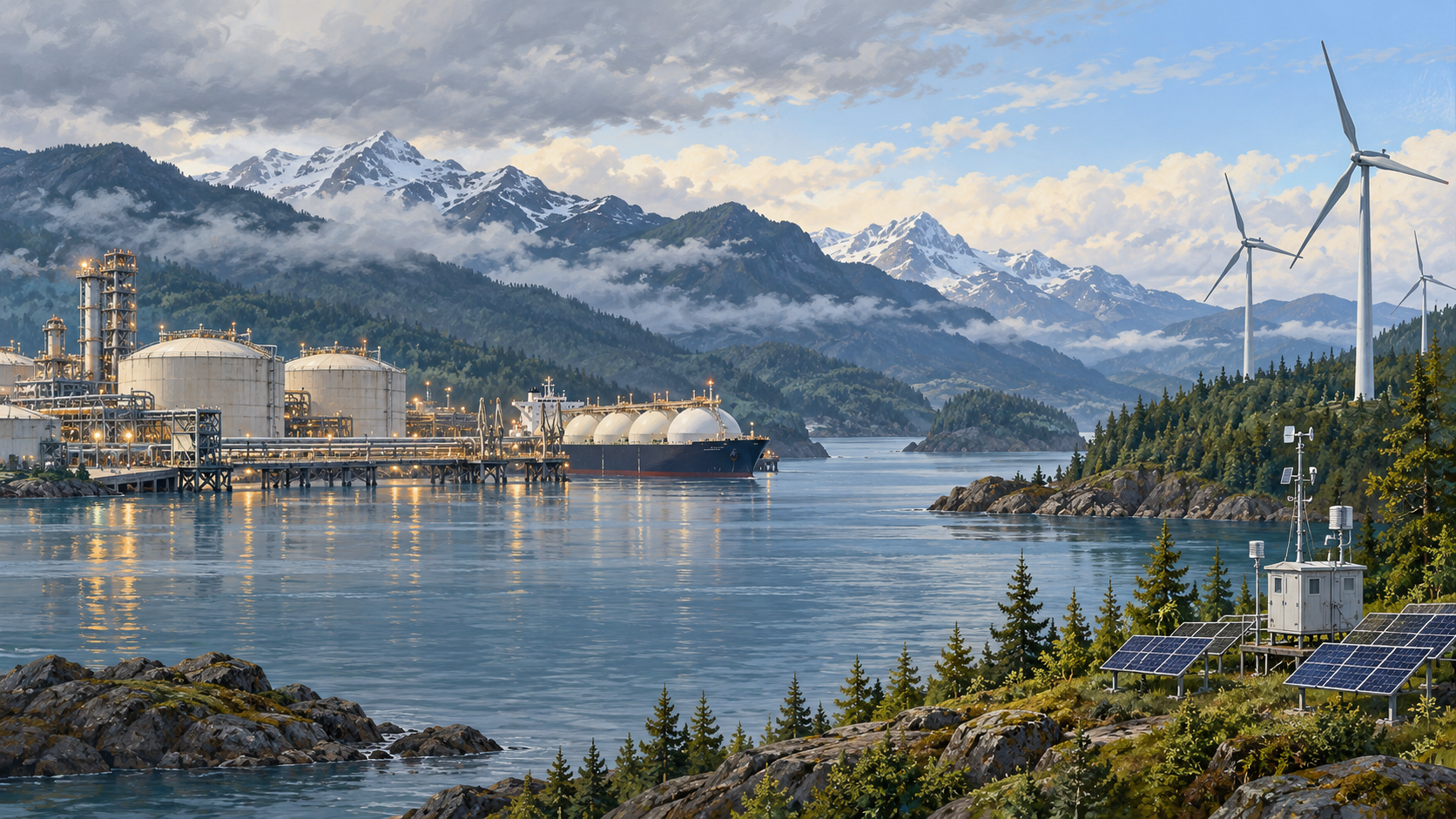
The decision to expand LNG Canada is more than another large energy announcement. It concentrates several of Canada's biggest economic questions in one project: trade diversification, Indigenous ownership, private investment, energy security, and the credibility of national climate commitments.
Beyond the familiar argument
That combination is why the expansion deserves scrutiny beyond the familiar argument over whether natural gas is good or bad. The more useful question is whether the economic and environmental claims about the project, by government and by Shell alike, can be demonstrated rather than asserted.
A substantial economic argument
The economic argument is substantial, and officials have not been shy about saying so. Phase 2 is expected to bring about 33 billion dollars in private investment and double the Kitimat facility's annual capacity to 28 million tonnes. Prime Minister Mark Carney has called the project proof that "Canada is building big and bold again," and Shell's chief executive has pointed to global LNG demand, which the company expects to grow by around 65 percent by 2050, as the commercial logic behind the expansion. That diversification has become more strategically important as Canada confronts uncertainty in its largest trading relationship. A Pacific export route does not eliminate exposure to the United States, but it gives Canadian producers access to customers that were previously much harder to reach directly.
An ownership dimension worth watching
An ownership dimension also distinguishes the project from many earlier resource developments. Five First Nations have an option to invest up to 1 billion dollars in an entity connected to the new storage tank, and nearly 5 billion dollars in contracts have already gone to First Nations and local businesses. Whether the larger equity option is ultimately exercised, on what terms, and with what long-term benefits, will matter when the project's claims about economic partnership are evaluated rather than announced.
The more complicated environmental side
The environmental side of the ledger is more complicated. Governments and project proponents emphasize that the Kitimat facility is designed to have lower emissions intensity than many competing LNG plants. Lower intensity matters, but it is not the same as zero emissions, and it does not, by itself, answer what happens to total emissions as production expands. The International Energy Agency notes that LNG carries emissions across extraction, processing, transportation, and liquefaction before the gas is ultimately burned, and that the emissions profile of natural gas varies widely, particularly because methane leakage can significantly affect the supply chain's climate impact.
A target Canada is not currently on track to meet
Canada's own climate numbers make this question difficult to avoid. The federal target for 2030 remains a reduction of 40 to 45 percent below 2005 levels. The government's 2025 progress report projected a reduction of about 21 percent under measures already in place, and 28 percent when it included additional measures. Those national projections do not prove that LNG Canada Phase 2 prevents Canada from meeting its target, nor does a claim of comparatively low emissions intensity prove that a larger LNG industry is automatically compatible with it. Both conclusions would go beyond the available evidence.
What a rigorous test would measure
The more rigorous test is measurable performance. How much of the announced investment is actually delivered? How many durable jobs result, beyond the construction period Ottawa has already estimated? What economic returns flow to the First Nations with an equity option? How much methane escapes across the supply chain? What are the facility's actual emissions once the expansion is operating? And what reductions occur elsewhere in the oil and gas sector and the wider economy to offset them?
Why neither side of the usual debate is sufficient
This approach avoids a common weakness in energy debates. Supporters can focus on jobs, exports, and energy security while treating climate effects as secondary. Critics can focus on fossil fuel expansion while discounting the economic value of market diversification or the possibility of genuinely lower emissions intensity. Neither approach captures the whole policy problem. Canada is trying to pursue several objectives simultaneously: stronger trade outside the United States, large-scale private investment, Indigenous economic participation, reliable energy exports, and declining national emissions. LNG Canada Phase 2 will become an unusually visible test of whether those objectives can coexist in practice.
The debate the final investment decision should start
The final investment decision therefore should not end the debate. It should make the debate more empirical. Governments, companies, and regulators now have a large, named project against which to measure their public claims. If the expansion delivers the promised economic benefits while emissions fall in line with Canada's stated trajectory, that evidence will matter. If investment and production rise while emissions reductions remain well short of national commitments, that evidence will matter too. For a country trying to define its economic strategy in a less predictable world, credibility will depend less on whether leaders describe Canada as an energy power or a climate leader, and more on whether the numbers eventually support both claims.
Comments
Join the conversation
Enter your email — we'll send a 6-digit code so you can post a comment. No password needed.
- Be the first to comment.