
Inflation Edges Up to 3.1 Per Cent as Gasoline Surges, but Grocery Price Growth Slows
Gasoline is up nearly 28 per cent from a year ago, while core measures hold near 2 per cent and store bought food prices rose the least since May 2024.
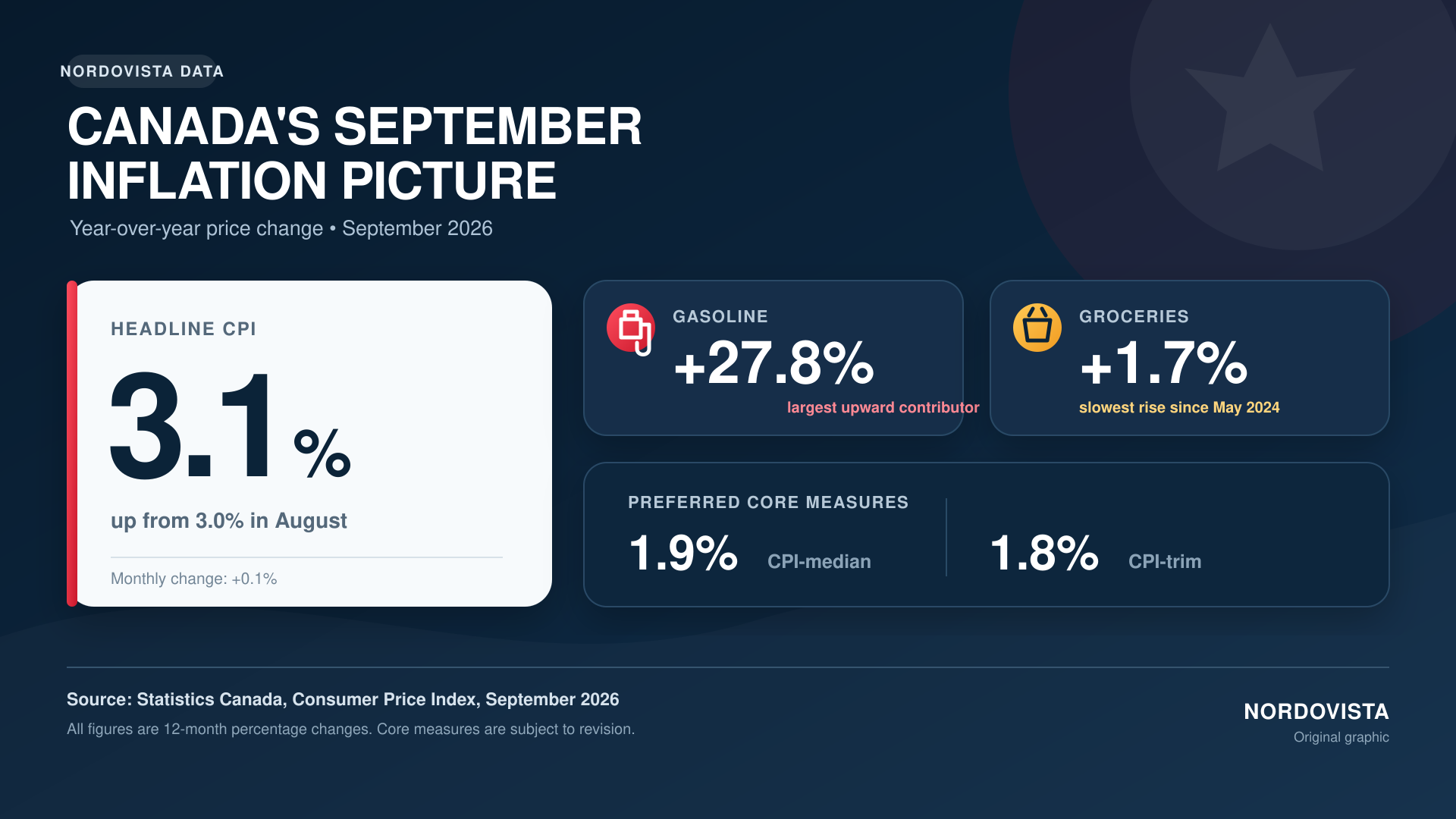
Higher gas prices pushed Canada’s annual inflation rate up to 3.1 per cent in September, even as food and underlying price measures cooled, Statistics Canada said Monday.
The rate was up from 3.0 per cent in August and slightly below the 3.2 per cent economists had expected, The Canadian Press reported.
Gasoline prices were up 27.8 per cent from a year earlier, despite the seasonal switch to a cheaper winter blend. Airfares rose 19.4 per cent on higher jet fuel costs, and fuel oil and other fuels climbed 57.8 per cent. Excluding gasoline, prices rose 2.2 per cent, down from 2.4 per cent in August.
Groceries cool
Prices for food bought in stores rose 1.7 per cent, the smallest annual increase since May 2024. Fresh vegetables fell 2.9 per cent and sugar and confectionery fell 2.7 per cent. Beef rose 8.7 per cent, slower than the 11 per cent jump in August.
Grocery prices are still about 33 per cent higher than they were in September 2020.
Core measures ease
The Bank of Canada’s two preferred measures of underlying inflation both slipped. CPI trim fell to 1.8 per cent from 1.9 per cent, and CPI median fell to 1.9 per cent from 2.0 per cent.
Inflation topped 5 per cent in the three Maritime provinces and was lowest in Ontario at 2.5 per cent.
What economists said
Douglas Porter, chief economist at BMO, said core measures holding near 2 per cent suggest that “the run up in prices really is not spreading far and wide beyond the gasoline pump.” He said the report “does nothing to advance the case for interest rate hikes.”
Andrew Grantham of CIBC Capital Markets said there is “little rush and policymakers can take more time” before the central bank raises rates.
Bank of Canada watching energy
Bank of Canada Governor Tiff Macklem warned last week that persistently high global energy prices will push up the inflation outlook, The Canadian Press reported Oct. 17. The news agency quoted him as saying, “You can only release strategic energy, oil reserves so many times.”
The central bank has said it is prepared to raise rates if needed. Its next rate decision is Oct. 28.
Why fuel and food can move in opposite directions?
Gasoline follows global oil markets, which are volatile. Food prices depend more on supply, competition, currency and weather, so a jump at the pump does not automatically lift the grocery bill. September’s figures show the gap: gasoline up 27.8 per cent, store bought food up 1.7 per cent.
Porter’s point is the one to watch. If higher fuel costs begin to feed into transport and food costs, core measures would rise from their current level near 2 per cent. That is the signal the Bank of Canada says it is watching, and the September report does not show it yet.
Comments
Join the conversation
Enter your email — we'll send a 6-digit code so you can post a comment. No password needed.
- Be the first to comment.