Von der Leyen Proposes Canada Become the EU's First Associate Member
The European Commission president floated a new category of EU relationship for Canada during her State of the Union address in Strasbourg, a proposal Ottawa has welcomed but that remains legally undefined and requires unanimous member state support.
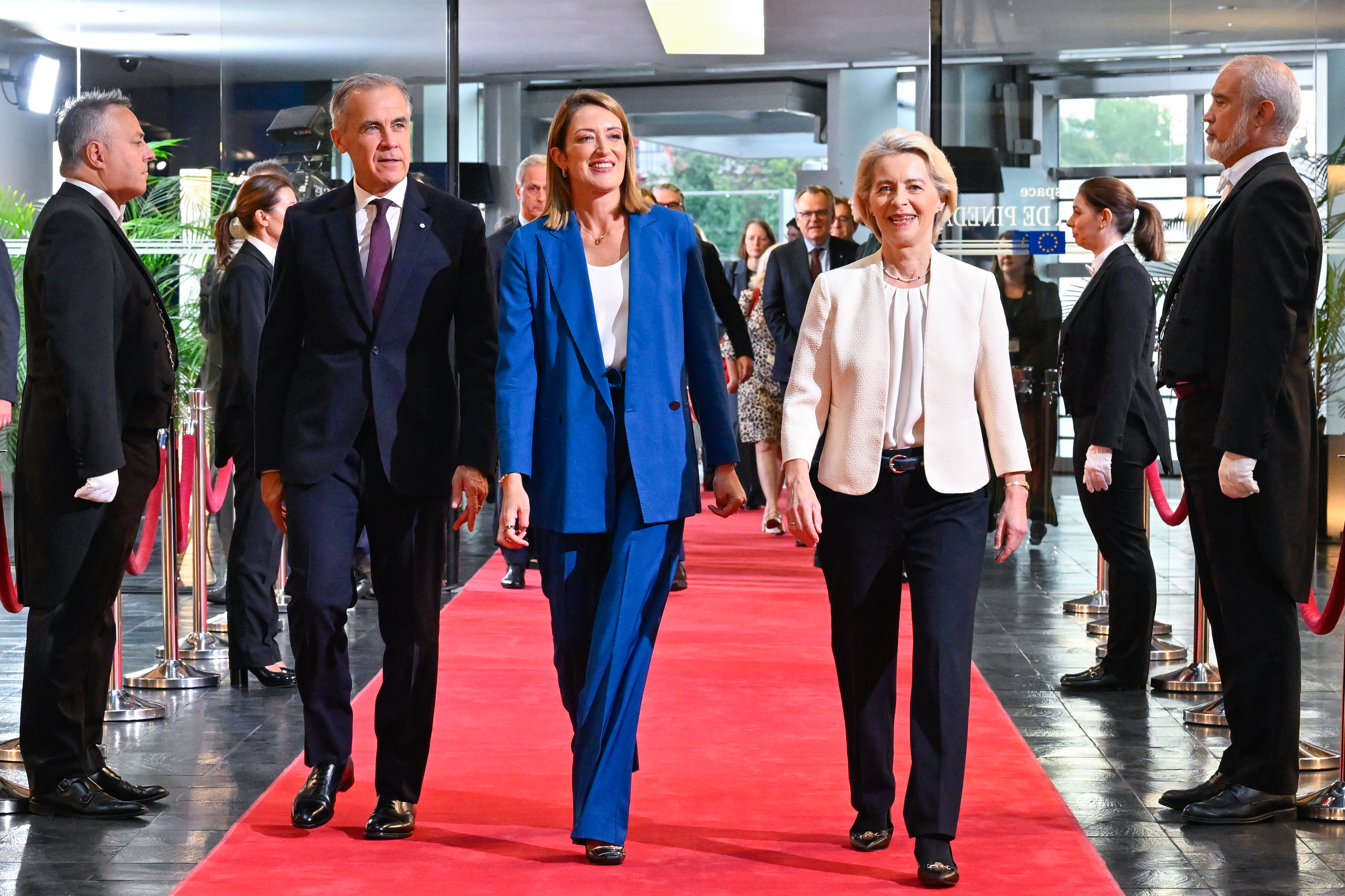
European Commission President Ursula von der Leyen proposed Wednesday that Canada become the European Union's first associate member, a new category of relationship with the bloc that does not currently exist, in a striking overture delivered as both Ottawa and Brussels seek to reduce their dependence on an increasingly hostile United States.
What von der Leyen actually said
Von der Leyen made the proposal during her annual State of the Union address at the European Parliament in Strasbourg, with Prime Minister Mark Carney seated in the front row as her special guest. I would like to work with you on opening the door for Canada being the first associate member of the EU, von der Leyen told Carney directly. She framed the relationship in terms that went beyond economics. Above all, dear Mark, Europe and Canada believe in democracy, she said, adding that we believe that power does not belong to the strongest, the richest or the loudest, but to all of us. That democracies have the freedom to choose with whom to work.
Moving beyond the existing trade agreement
Canada and the EU already have a trade relationship through CETA, the Comprehensive Economic and Trade Agreement, which eliminated 99 percent of tariff lines when it provisionally came into force in 2017. Von der Leyen described the proposal as a step beyond that existing framework. We will move from CETA to an alliance for the future, to create a common prosperity and economic security space, she said, describing the two sides as sharing one ocean, one set of values, one way of seeing the world.
How Ottawa has responded
Carney's office welcomed the proposal, saying Canada was deepening ties with the EU to strengthen our sovereignty and supported moving beyond CETA toward what von der Leyen called an alliance for the future. The proposal followed Carney's own comments earlier in the week, when he said Canada was seeking a unique alliance with the EU, but not full membership, a distinction that matters given roughly 70 percent of Canadian exports currently go to the United States, and Carney has repeatedly framed closer EU ties as a way to reduce that dependence.
Not a new idea, but a new level of seriousness
Von der Leyen's proposal builds on ideas floated earlier this year. Finnish President Alexander Stubb said in June that the EU should consider expanding to 40 member states and specifically named Canada, the United Kingdom, Turkiye, Norway and Iceland as potential candidates, framing the idea partly as a response to President Trump's repeated suggestion that Canada become the 51st US state. Wouldn't it be lovely if Canada was the 28th state of the European Union rather than the 51st state of the United States, Stubb said at the time. Wednesday's proposal marks the first time a sitting European Commission president has put a concrete institutional category, associate membership, behind that earlier rhetoric.
Why this is an opening, not an outcome
The proposal remains politically and legally undefined. Associate membership is not an existing EU category, meaning its scope, obligations and privileges would need to be negotiated and would require unanimous agreement among all 27 EU member states. According to NPR, some EU governments were reportedly furious they were not consulted before von der Leyen's offer, suggesting resistance may emerge in capitals whose support would be necessary. Analyst Aaron Gasch Burnett of the Centre for Strategic Statecraft noted that both Carney's political supporters and opponents in Canada have already seized on the idea, reflecting genuine uncertainty in Ottawa over what associate membership would actually require Canada to accept.
What would make this real
For now, Wednesday's speech represents a significant diplomatic opening rather than an accomplished institutional change. The Atlantic Council's Jorn Fleck described von der Leyen's embrace of Canada, itself in a trade war with the United States, as a signal in its own right about how much the broader geopolitical rupture is reshaping leaders' calculations in a changing world order. Whether that signal becomes a concrete framework will depend on negotiations among EU member states that have not yet begun in earnest.
Comments
Join the conversation
Enter your email — we'll send a 6-digit code so you can post a comment. No password needed.
- Be the first to comment.