Canada Puts Strategic Autonomy at Centre of Its Foreign Policy
Foreign Affairs Minister Anita Anand told the United Nations General Assembly that a changing global order requires less dependence on any single partner and deeper cooperation among middle powers.
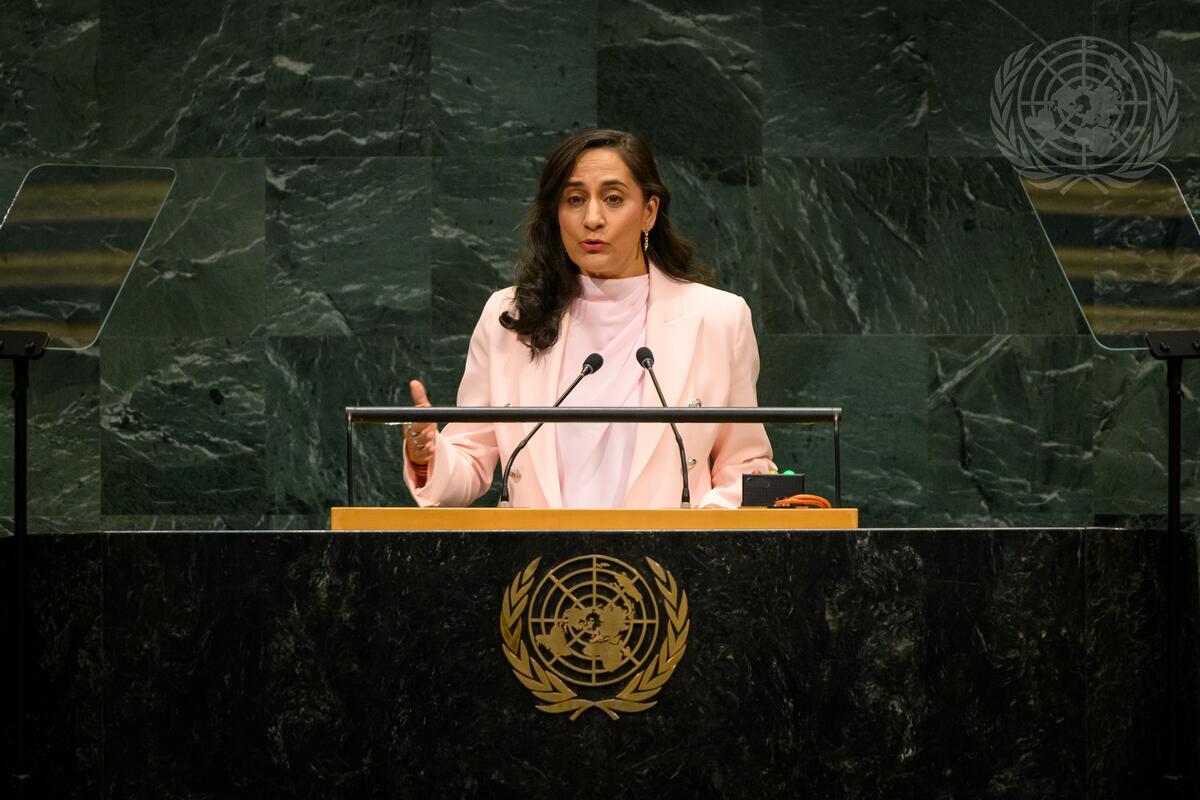
Canada has placed strategic autonomy at the center of its foreign policy, using its address to the United Nations General Assembly to argue that the country must reduce dependence on any single partner while building stronger relationships across a more fragmented international system.
Foreign Affairs Minister Anita Anand delivered Canada’s national address in New York on Saturday. “In the face of this rupture,” she told the assembly, “Canada’s goal is to achieve greater strategic autonomy,” so the country can “make our own choices, and to determine our own, sovereign future.” She added plainly, “We can no longer afford to be overly reliant on any one partner.”
Middle powers and issue based coalitions
Anand argued that countries like Canada, middle powers rather than global superpowers, are “playing a key role in building the framework for the new international order.” Rather than relying only on established multilateral bodies, she pointed to “issue-based coalitions” as “the most flexible, effective and immediate way” to address global challenges, from security to supply chains.
That approach follows the foreign policy direction Prime Minister Mark Carney’s government has pursued through 2026: deeper relationships with the European Union, individual European countries, and Indo-Pacific partners, alongside an effort to diversify commercial ties beyond the United States.
Trade diversification with real numbers behind it
Anand said Canada is “exploring new opportunities with partners in the Indo-Pacific, the Gulf, and Latin America” and building “renewed partnerships with large economies, such as India and China.” She pointed to Canada’s recent Investment Summit in Toronto, which secured close to 500 billion dollars in investment commitments, as evidence that diversification is producing concrete results rather than remaining a diplomatic talking point.
The trade diversification push has already shown up in specific agreements. Canada and Germany signed a new agreement this week governing the exchange and protection of classified information, alongside discussions on defense, critical minerals, artificial intelligence, and economic cooperation. Separately, Canadian officials say trade negotiations with the Philippines and with the Association of Southeast Asian Nations are more than 90 percent complete, with Ottawa hoping to finish both before Carney travels to Southeast Asia in November.
Ukraine, the Arctic, and the Middle East
On Ukraine, Anand said Canada remains “resolute in our support” and committed to “a comprehensive, just and lasting peace” built on Ukraine’s “sovereignty and territorial integrity.” She also raised Russia’s abduction of Ukrainian children as an unresolved humanitarian concern.
On the Arctic, she called the region “central to our identity, our security and our future.” She welcomed the recent security arrangement among the United States, Greenland, and Denmark, saying “North America and Europe are stronger together.”
On the Middle East, Anand said a two-state solution “remains the guiding principle” of Canadian policy, called Israeli settlements in the occupied West Bank “illegal under international law,” and announced new restrictions on trade connected to those settlements. She also referred to Hamas’s attacks on Israel and to settler violence against Palestinians.
A synagogue attack in her own remarks
Anand’s address also turned to hate-based violence inside Canada. “We were tragically reminded of the scourge of antisemitism again,” she said, “when a gunman carried out an attack on a synagogue in Belleville, Ont.” The reference was to the September 24 shooting outside a Belleville synagogue during Yom Kippur services, in which a police officer was seriously wounded. Belleville police have called it a deliberate, hate-motivated attack against the Jewish community.
Multilateralism and what comes next
Anand also announced a new initiative, Partners for Multilateralism, to support United Nations reform and make its institutions “more representative, effective, and trusted.”
Canada remains deeply integrated with the United States economically and geographically, and Europe and Asia cannot quickly replace the scale and proximity of the American market. Strategic autonomy, as Anand described it, is better understood as an attempt to widen Canada’s options than to sever its existing relationships. The clearer test will be whether the trade talks now nearing completion, and the partnerships announced through this year’s diplomatic visits, produce measurable results in the months ahead.
Comments
Join the conversation
Enter your email — we'll send a 6-digit code so you can post a comment. No password needed.
- Be the first to comment.