
BRICS Summit Calls for Middle East Restraint as Xi and Modi Offer to Help Broker Ukraine Talks
Leaders meeting in New Delhi overcame months of internal division to issue a joint declaration on the Middle East. At the same time, China and India separately offered to help facilitate Ukraine peace talks, an offer Vladimir Putin welcomed.
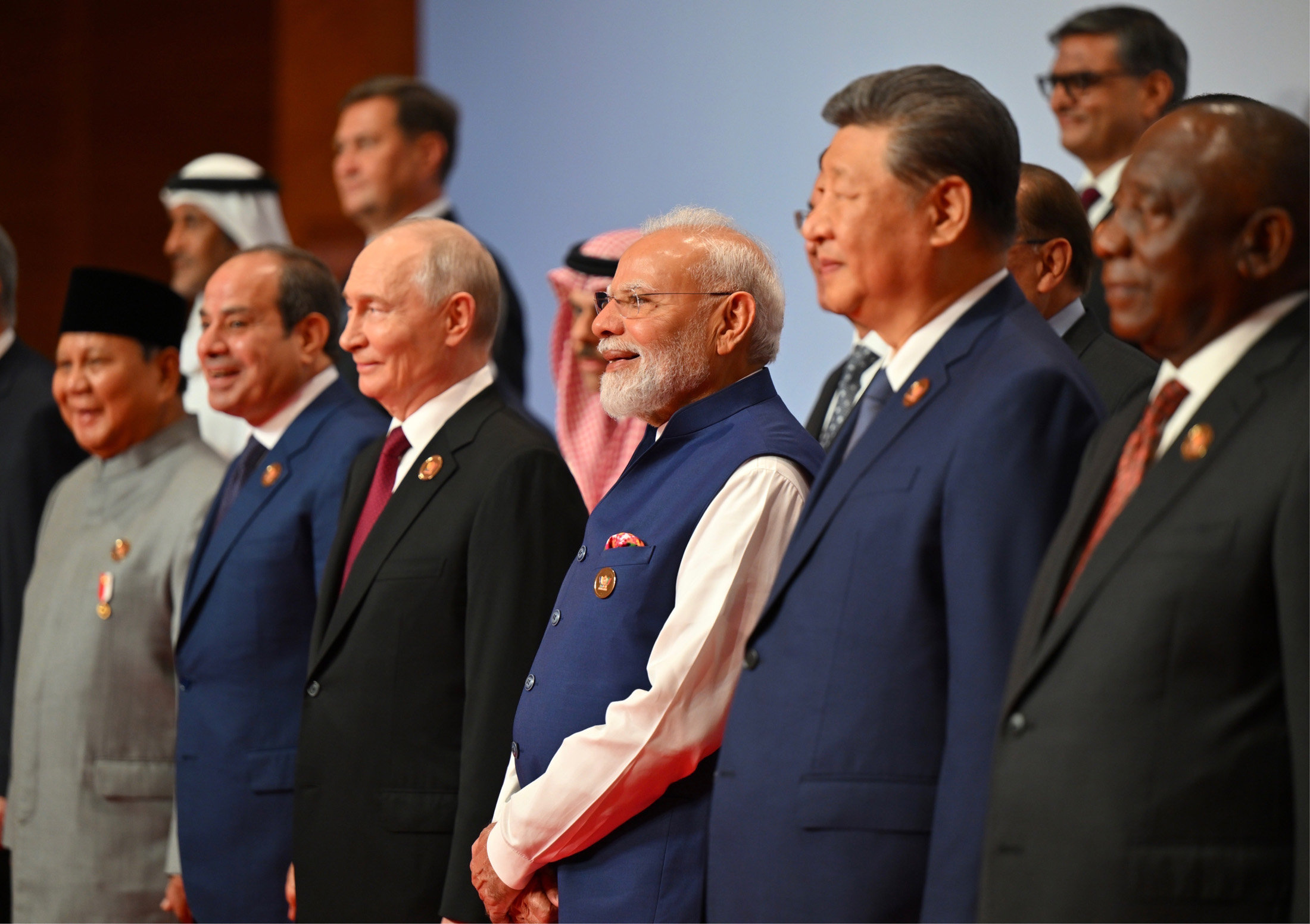
BRICS leaders concluded their two-day New Delhi summit with a broad push for deeper economic cooperation, a joint declaration calling for restraint in the Middle East, and a notable offer from China and India to help facilitate Ukraine peace talks, showing the expanded group can still reach consensus despite significant political differences among its members.
A declaration that almost did not happen
The joint declaration voiced deep concern over the continued escalation of tensions in the Middle East and West Asia, calling for maximum restraint and warning against deliberate attacks on civilian infrastructure and nuclear facilities in particular, according to Al Jazeera. It reiterated the bloc's firm opposition to the forced displacement of Palestinians and to changing the geography or demography of occupied Palestinian territory. Reaching that agreement was notable specifically because it overcame divisions that had prevented the group from issuing any joint statement at a foreign ministers meeting in May, according to The National, a gap that took intense diplomatic effort, including by summit host India, to close this time.
An offer on Ukraine the summit was not expected to produce
Beyond the Middle East, Xi Jinping and Narendra Modi both separately offered to help facilitate peace talks on Ukraine during the summit, with Russian President Vladimir Putin welcoming their readiness to do so, according to The National's reporting on the summit's conclusion. Putin separately described BRICS as a driving force toward building a new, fairer, multipolar world order and urged member countries to find ways to integrate their economies' competitive advantages, Reuters reported.
What leaders said, in their own words
Modi framed the bloc's growing weight in personal terms in his closing remarks. BRICS has grown because their voices are heard, experiences are respected, and solutions are developed not for them, but together with them, Modi said. He separately told leaders that the Global South must transition from being rule takers to becoming rule shapers on the world stage. Iranian President Masoud Pezeshkian offered his own framing of the bloc's purpose. BRICS is a sign of a growing demand for a more balanced and inclusive world, in which no power center has the right to determine the fate of others, Pezeshkian said.
A high stakes bilateral on the sidelines
The summit also produced a notable bilateral meeting between Modi and Xi, in which both sides agreed that differences between them should not convert to disputes, according to WION's live coverage of the summit. Iran's Pezeshkian and Sheikh Khaled bin Mohamed, Crown Prince of Abu Dhabi, also held a separate bilateral meeting, which Reuters and the Associated Press described as part of a broader effort to lower regional tensions amid severe disruption around the Strait of Hormuz and the Red Sea.
Who was in the room
The 11-member bloc's attendee list at this summit shows how far BRICS has expanded beyond its five founding members. Also attending were Sheikh Khaled bin Mohamed, Crown Prince of Abu Dhabi; Egyptian President Abdel Fattah El Sisi; and Saudi Foreign Minister Prince Faisal bin Farhan, according to The National, alongside foreign ministers of Iran, Russia, and China, who held separate talks on the summit's sidelines. New Delhi was placed under an intense security presence for the event, with more than 15,000 police personnel and 200 paramilitary companies deployed, according to WION.
The economic agenda beneath the diplomacy
The declaration also called for greater use of local currencies in trade, stronger cross-border payment systems, and deeper cooperation on food security, energy, artificial intelligence and climate policy. China used the summit to advance what Xi described as a broader Greater BRICS framework built around closer cooperation in trade, artificial intelligence, finance and special economic zones, according to Reuters. Modi, for his part, emphasized that the bloc should not be understood simply as an anti-Western alliance, framing BRICS instead as a platform for Global South countries to gain more influence over international rules and institutions.
Why consensus remains harder than agreement in principle
That distinction matters because members do not share a single geopolitical strategy. India maintains important relationships with the United States and Europe, while China and Russia often seek to reduce Western influence. Iran faces extensive Western sanctions, while several Gulf members maintain close economic and security ties with Washington. The summit therefore demonstrated both BRICS's strength and its limits. Its members can agree on broad demands for reform, development financing and greater representation, and on this occasion managed a joint position on the Middle East that eluded them in May, but translating those positions into coordinated policy remains considerably more difficult, and offers of Ukraine mediation are not the same as an actual negotiating process.
What would confirm this was more than rhetoric
The economic agenda may prove more durable than the political rhetoric, since cooperation on payments, artificial intelligence, infrastructure and trade can expand even when members disagree on security issues. The New Delhi summit also comes at a moment when disruptions to energy markets and supply chains are increasing the appeal of alternative trade and financial arrangements for many emerging economies. The next phase will show whether the new initiatives announced in New Delhi, and the Ukraine mediation offer specifically, become functioning efforts or remain declarations of intent. The bloc's influence will ultimately depend less on summit language than on whether members can convert political ambition into practical cooperation.
Comments
Join the conversation
Enter your email — we'll send a 6-digit code so you can post a comment. No password needed.
- Be the first to comment.