
Beyond the Criminal Case: The Political Questions Behind Turkiye's Suleymancilar Operation
A sweeping financial investigation into a century old religious community raises familiar questions about selective justice, echoing the Gulen crackdown and the prosecution of Kurdish politicians, opposition mayors and independent journalists.
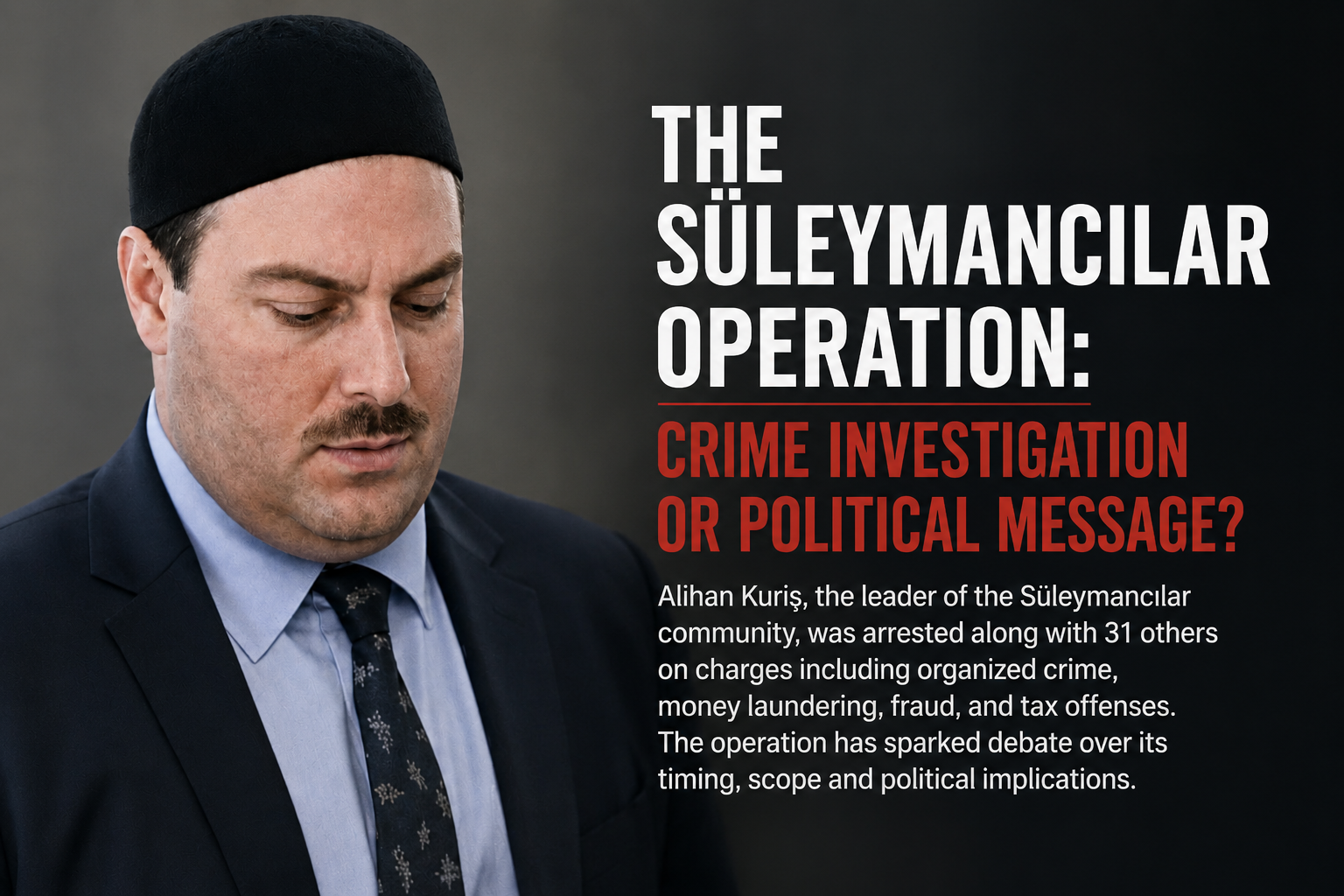
The sweeping investigation into Türkiye's Suleymancilar religious community raises a question that has become increasingly familiar in Turkish public life: where does legitimate law enforcement end and political intervention begin?
On August 13, prosecutors ordered the detention of 49 suspects in an investigation spanning 17 provinces and 123 addresses. Alihan Kuris, regarded as the leader of the Suleymancilar community, was among those detained. On August 16, Kuris and 31 others were formally arrested, while six suspects were released under judicial supervision. Prosecutors accuse members of the group of offences including establishing or managing a criminal organization, money laundering, fraud against public institutions and violations of tax law.
These are serious allegations and should not be dismissed merely because those accused belong to a religious community. Reports that investigators seized substantial assets, including around 200 kilograms of gold from one location, give authorities legitimate questions to investigate.
But acknowledging that does not settle the larger issue.
The central question is not whether religious organizations should be immune from investigation. Clearly, they should not. The more difficult question is whether Türkiye today possesses sufficiently independent institutions to convince the public that politically sensitive investigations are conducted solely according to law.
Why now?
That question becomes particularly significant because the operation did not emerge in a political vacuum.
Kemal Can, a veteran journalist and longtime analyst of political Islam and religious communities in Türkiye, argues that the operation cannot be read in isolation from the government's shifting approach to religious networks over the past twenty five years. In his assessment, the timing points beyond the financial allegations alone, situating the crackdown within a broader realignment of the ruling party's relationship with the CHP, the DEM Party and other opposition forces.
This interpretation deserves attention because the relationship between Türkiye's governments and religious communities has historically been pragmatic rather than fixed. Groups tolerated or courted during one political period can become targets during another when alliances, electoral calculations or power relationships change.
That history does not prove that the Suleymancilar investigation was politically ordered. But it makes the political context impossible to ignore.
A broader pattern
International assessments of Türkiye's justice system make the question still more consequential.
Human Rights Watch argues that Türkiye's government exercises extensive influence over domestic courts and has repeatedly failed to implement binding judgments of the European Court of Human Rights. Its 2026 assessment describes a continuing deterioration in judicial independence alongside intensified legal pressure on political opposition.
This concern extends beyond human rights organizations. Reuters has repeatedly reported that corruption and criminal investigations against opposition politicians have been denounced by government critics as politically motivated, while Turkish authorities maintain that prosecutors and courts operate independently.
That distinction is essential. Neither criticism from international organizations nor Türkiye's record in other cases proves misconduct in the Kuris investigation.
But institutional credibility is cumulative.
When opposition politicians, journalists, activists, civil society figures and members of religious movements repeatedly encounter expansive criminal investigations, pretrial detention or organizational accusations, every subsequent operation is inevitably interpreted through the experience of those preceding it.
Comparable cases across the political and religious spectrum
The Suleymancilar operation is not an isolated event in Turkish legal history. It fits a recognizable pattern that has touched religious communities, Kurdish political movements and, more recently, the country's largest opposition party, each treated by prosecutors through remarkably similar legal instruments: organized crime statutes, terrorism charges or sweeping financial fraud allegations.
The Gulen movement
Türkiye's experience with the Gulen movement remains the most far reaching precedent, although the two communities and the allegations against them should not be equated. Once a close ally of the governing party, the movement was designated a terrorist organization after the failed coup attempt of July 2016. Human Rights Watch has documented mass prosecutions in the years that followed, involving hundreds of thousands of people dismissed from public service, detained or convicted largely on the basis of alleged organizational membership rather than individualized criminal acts. The European Court of Human Rights, in the Yalcinkaya case, found that Turkish courts had arbitrarily applied membership of an armed organization charges by treating the use of an encrypted messaging application and other lawful, everyday affiliations as proof of guilt. That ruling is now widely cited as a warning about how loosely defined concepts such as organizational membership can be stretched to cover an entire social network.
Kurdish political movements
Pro Kurdish parties have faced a parallel pattern for decades, with the Peoples' Democratic Party, HDP, offering the clearest recent example. More than a hundred HDP politicians were prosecuted over the 2014 Kobani protests, in which more than thirty people died amid anger over Türkiye's perceived inaction as Islamic State forces besieged the Syrian border town. In May 2024, a Turkish court convicted dozens of HDP figures, including former co chair Selahattin Demirtas, who received a sentence exceeding forty years. Defense lawyers and international observers described the trial, which took years to reach verdict despite relying on evidence largely unchanged since 2014, as a political case rather than a straightforward criminal one. The European Court of Human Rights later found that Türkiye had violated Demirtas's rights. Separately, a Constitutional Court case seeking closure of the HDP, filed in 2021 and still active, would bar hundreds of politicians from party activity for years. Turkish officials frame these actions as necessary responses to the party's alleged links to the Kurdistan Workers' Party, PKK, which Türkiye, the United States and the European Union classify as a terrorist organization. The HDP and its successor, the DEM Party, deny any organizational connection and argue that peaceful political activity and calls for solidarity have been recast as criminal acts.
The main secular opposition
Perhaps the most consequential recent example involves not a religious or ethnic minority movement but Türkiye's largest opposition party. In March 2025, Istanbul Mayor Ekrem Imamoglu, widely regarded as President Recep Tayyip Erdogan's most formidable electoral rival, was detained and later jailed pending trial on corruption charges tied to municipal contracts. He was indicted in November 2025 on 143 counts, prosecutors describing him as the leader of a criminal organization built to capture control of the Republican People's Party, CHP, itself. His arrest came days before the CHP was scheduled to name him its presidential candidate, and it triggered the largest antigovernment protests Türkiye had seen in a decade, along with more than a thousand detentions among demonstrators. Human Rights Watch has noted that the Istanbul prosecutor who led the investigation was appointed to that post shortly before the case began and was later promoted to justice minister upon its completion, a sequence the organization says illustrates how closely prosecutorial appointments and outcomes can track political calculations. Imamoglu denies all charges and has since been formally endorsed as the CHP's candidate for 2028. Turkish officials, including President Erdogan, reject any suggestion of political motivation and insist the judiciary acted independently.
Opposition media
The pattern extends to journalism as well. In October 2025, Merdan Yanardag, editor in chief of the opposition channel Tele1, was jailed alongside Imamoglu and businessman Necati Ozkan on espionage charges. Tele1, among the few Turkish broadcasters still openly critical of the government, was placed under the control of the Savings Deposit Insurance Fund, TMSF, after his arrest and later put up for sale at a price colleagues and press freedom advocates described as far below its market value. Writing from prison, Yanardag argued that the case against him was aimed less at proving espionage than at silencing the channel and dismantling its independent ownership. Turkish authorities maintain the investigation followed standard legal procedure and reject any suggestion that it targeted the outlet for its editorial line.
Taken together, these cases span a religious brotherhood, a Kurdish political movement, a secular opposition party and an independent broadcaster, representing very different segments of Turkish society. What links them is not shared ideology but a shared legal architecture: organized crime, espionage and terrorism statutes broad enough to convert institutional affiliation itself into evidence, applied at moments that closely track shifts in the political landscape.
Law enforcement or political signalling?
The Suleymancilar case therefore presents two possibilities that are not necessarily mutually exclusive.
The first is straightforward: prosecutors may possess substantial evidence of financial crimes that requires investigation and prosecution.
The second is political: authorities may simultaneously be using a legitimate or partially legitimate criminal investigation to reshape a religious network, discipline an autonomous centre of social influence or signal to other communities that political distance from the state carries consequences.
Indeed, political instrumentalization does not require criminal allegations to be entirely fabricated. In hybrid or highly centralized political systems, the more subtle concern is often selective enforcement: who is investigated, when an investigation begins, how aggressively prosecutors proceed and whether comparable conduct receives comparable treatment elsewhere.
That is why the most revealing question may not be "Did crimes occur?" but rather: Would the state have acted in precisely the same way if the political relationship between the community and those in power were different?
At present, there is insufficient publicly available evidence to answer that question conclusively.
But there is more than enough context, including the Gulen prosecutions, the Kobani trial and the Imamoglu case, to justify asking it.
The real test comes next
The credibility of the investigation will ultimately depend less on dramatic raids or quantities of seized assets than on what happens in court.
Prosecutors must demonstrate individual criminal responsibility rather than treating religious affiliation as evidence of guilt. Defendants must have meaningful access to evidence and counsel. Courts must distinguish between legitimate religious, educational and commercial activity and conduct that actually constitutes a criminal offence.
Above all, the proceedings must be transparent enough to demonstrate that the same legal standards would apply to organizations close to the government.
If prosecutors can establish the allegations through independently tested evidence, political criticism should not shield anyone from accountability.
If, however, organizational affiliation, political positioning and financial networks become substitutes for individualized evidence, as critics argue occurred in the Gulen and Kobani cases and now allege in the Imamoglu prosecution, the Suleymancilar operation will reinforce an already widespread perception that criminal law in Türkiye can function not only as an instrument of justice but also as an instrument for managing political and social power.
The arrest of Alihan Kuris therefore represents something larger than the fate of one religious community.
It is another test of an increasingly important question in contemporary Türkiye: Can the state investigate powerful organizations, whether religious, ethnic or political, without creating reasonable doubt that the judiciary is also being used to rearrange the political landscape?
For a justice system, the appearance of impartiality is not a secondary concern. It is part of justice itself.
Comments
Join the conversation
Enter your email — we'll send a 6-digit code so you can post a comment. No password needed.
- Be the first to comment.