BC Wildfire Charities Were Overwhelmed by Donations Within Days, A Pattern Canadians Keep Repeating
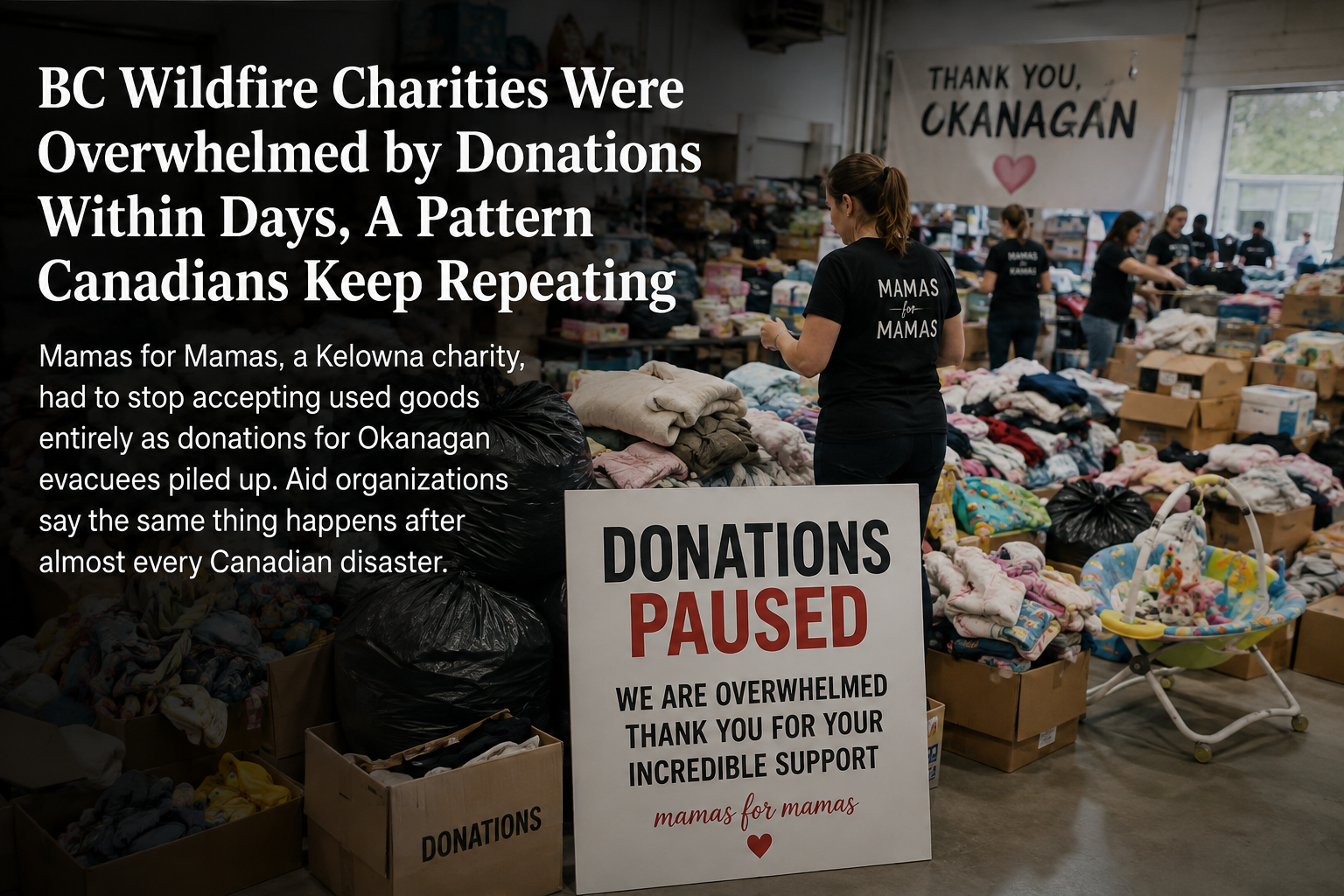
Mamas for Mamas, a Kelowna charity, had to stop accepting used goods entirely as donations for Okanagan evacuees piled up. Aid organizations say the same thing happens after almost every Canadian disaster.
When the Bald Range wildfire forced more than eighteen thousand people from their homes across British Columbia’s Okanagan region earlier this month, the response from nearby communities was immediate and, by the account of the organizations receiving it, overwhelming almost to the point of becoming its own problem.
Mamas for Mamas, a Kelowna based charity that became a central collection point for evacuees, said it received so many donations of used clothing, toiletries and household goods that it had to stop accepting them entirely within days, according to reporting by Global News. As the Summerland fire blew up, donations also blew up, said Lindsay Hamond, the charity’s director of programs and services, in comments carried by KelownaNow. Kelowna really knows how to help, she said, describing how the organization’s parking lot filled with volunteers sorting what she called a mountain of donations. Kelly Wilson, a manager with Mamas for Mamas, described the response in similarly striking terms to Global News. People heard, people answered, she said. I got goosebumps. It was a well oiled machine in the emergency that it was.
That same pattern, an initial wave of donated goods that quickly exceeds what volunteers can sort and distribute, showed up across the wider Okanagan response. In Penticton, the Salvation Army specifically asked would be donors to bring clothing and household items to its thrift stores rather than directly to evacuation centres, according to Black Press Media reporting carried by the Kelowna Capital News and Penticton Western News, saying it had the capacity to manage donations there and make them available to evacuees through shopping vouchers. Salvation Army Captain Jennifer Henson told Black Press Media the organization’s teams had been preparing and serving two hundred meals three times a day since the first day of evacuations. OneSky Community Resources, running an emergency donation centre out of Okanagan College in Penticton, published and regularly updated a list of specifically needed items on its own website and explicitly asked donors not to bring food or unlisted clothing, noting that unrequested items create more work for volunteers rather than helping evacuees directly.
Aid organizations across the province have converged on a consistent message as a result: financial donations, not physical goods, are almost always more useful in the early days of a disaster response. The BC government’s own public guidance, cited by CHEK News, echoes this, describing cash donations to trusted organizations as the most effective way to support wildfire evacuees, while cautioning residents against wiring money directly or donating outside verified channels. Mamas for Mamas has continued accepting gift cards, useful for evacuees needing groceries or hotel rooms on short notice, even after closing its doors to used goods, according to KelownaNow’s reporting.
This is not a new problem specific to the Okanagan fires. Disaster response organizations across Canada have described the same dynamic after floods, wildfires and other emergencies for years, according to background reporting reviewed for this piece: a genuine and immediate outpouring of community generosity that, without coordination, produces more unsorted material than volunteers already stretched thin by an active emergency can realistically process. What made the Okanagan response notable was less the existence of the problem than how quickly organizations recognized it and pivoted, closing physical donation channels within days rather than weeks and redirecting would be donors toward cash, gift cards and specific, published needs lists instead.
For readers anywhere in Canada, the lesson embedded in this response is a practical one that will likely be relevant again: when disaster strikes a neighbouring community, checking an organization’s specific, current needs list before donating, and defaulting to cash or gift cards over used goods, does more good than acting on instinct alone. It is a small piece of disaster literacy that recurs almost every fire season, in almost every region of the country, and rarely gets explained until the next emergency is already underway.
Comments
Join the conversation
Enter your email — we'll send a 6-digit code so you can post a comment. No password needed.
- Be the first to comment.